
10 Best Party Lights That Sync to Music and Create Any Vibe
This post contains affiliate links. As an Amazon Associate, we earn from qualifying purchases.
The best party lights create immersive, dynamic environments by syncing to music, offering multi-color effects, and fitting your specific space. Prioritize lights with independent segment control (RGBIC over basic RGB), built-in microphones for sound activation, and an IP65 weatherproof rating if used outdoors. Control via a dedicated app, like Govee Home, provides the most flexibility for creating custom scenes.
Most people buy lights that only do one thing. They get a basic RGB strip that glows a single color, or a laser that just spins in a fixed pattern. The room feels flat. The magic happens when lights react, to the music, to a voice command, to a pre-programmed scene that shifts the mood from dinner to dance floor in three seconds.
This guide breaks down the ten lights that actually transform a space, not just illuminate it. We’ll cover the technical specs that matter, how to avoid the common coverage mistake, and how to layer different types for a pro-grade effect.
Key Takeaways
- RGBIC is non-negotiable for dynamic effects. Basic RGB lights show one color at a time. RGBIC (Independent Control) strips can run rainbows, chases, and multi-zone patterns because each segment is addressable.
- Sound activation requires a built-in microphone. Don’t assume all “music sync” lights have one, some require a constant app connection. A built-in mic means the lights work autonomously once set.
- IP65 is the minimum for outdoors. This rating means dust-tight and protected against water jets. IP44 is only splash-resistant and won’t survive a surprise rain shower.
- Beam angle dictates coverage. A 105° beam angle from a height of 10 feet covers a 20-foot diameter circle on the floor. A 60° beam from the same height covers only a 10-foot circle.
- App control unlocks scenes, schedules, and smart home integration. A physical remote is convenient, but an app lets you save complex color combinations, set timers, and link lights to Alexa or Google Home routines.
What Type of Party Light Actually Fits Your Vibe?
You need to match the light’s output and effect to the room’s purpose. Ambient lighting for a cocktail hour is different from the strobing effects for a dance floor.
Wash Lighting floods an area with color. This is your foundation. LED light strips, like the Govee RGBIC Pro, are the prime example. You stick them along ceilings, behind bars, or under furniture. They provide the base color that defines the room’s mood, deep blue for a lounge, bright pink for a party.
Effect Lighting creates movement and focus. Disco balls, laser projectors, and moving head lights fall here. The Nequare Disco Ball with its rotating mirror and multi-directional LEDs is a classic. A laser, like the Aomees 3-in-1 Projector, throws precise patterns and grids onto walls and ceilings. This layer adds the “wow” factor.
Accent Lighting adds detail and depth. Think fairy lights, string lights, or pinspots. The Etopgo 33ft Copper Wire Fairy Lights are perfect for draping over greenery, weaving through centerpieces, or highlighting specific decor. They don’t provide broad illumination, but they make the space feel finished.
Common mistake: Using only effect lighting in a large room, the lasers look cool but leave the majority of the space in darkness, killing the energy. Always layer a wash light underneath your effects.
| Lighting Type | Best Placement | Creates This Vibe | If You Skip It… |
|---|---|---|---|
| Wash (LED Strips) | Ceiling perimeter, behind TV, under bar | Immersive color backdrop | The room feels like a standard lit space with random laser dots. |
| Effect (Disco Ball/Laser) | Center of dance floor, angled at a feature wall | Dynamic, moving energy | The party lacks a focal point and feels static. |
| Accent (Fairy/String Lights) | Draped over decor, along table runners, in plants | Intimate, detailed, magical | The space feels industrially lit, not decorated. |
TL;DR: Build your lighting in layers: wash lights for the base color, effect lights for movement, accent lights for detail. One type alone looks incomplete.
RGB vs. RGBIC: What’s the Real Difference?
This is the single most important spec on any LED strip or smart bulb. Getting it wrong limits your entire setup.
A standard RGB light has one LED chip per diode. The chip mixes red, green, and blue to produce any single color. The entire strip must be that one color. You can set it to blue, or purple, or orange, but only one at a time.
An RGBIC light uses addressable LEDs, often WS2812B chips. Each segment (usually 3–6 LEDs) can be controlled independently. This lets the strip display a rainbow, a color chase that runs its length, or multiple static colors in different zones. The “IC” stands for Integrated Circuit, the tiny chip on each segment that allows this.
The Govee RGBIC Pro strip can display a sunset gradient (orange at one end, fading to deep blue at the other) while simultaneously running a twinkling white star effect over the top. A basic RGB strip cannot do this, it’s one color, period.
The difference is in the controller and the LED density. RGBIC controllers have more complex circuitry to send data to each segment. If you try to use an RGBIC strip with a basic RGB controller, it will either not work or only light up as a single color.
Why does this matter for a party? Static color is for ambiance. Dynamic, multi-color effects are for energy. A color chase that races to the beat of a drum makes people move. A slow, flowing rainbow across the ceiling is hypnotic. You need RGBIC for that.
The Control Panel: Remote, App, or DMX?
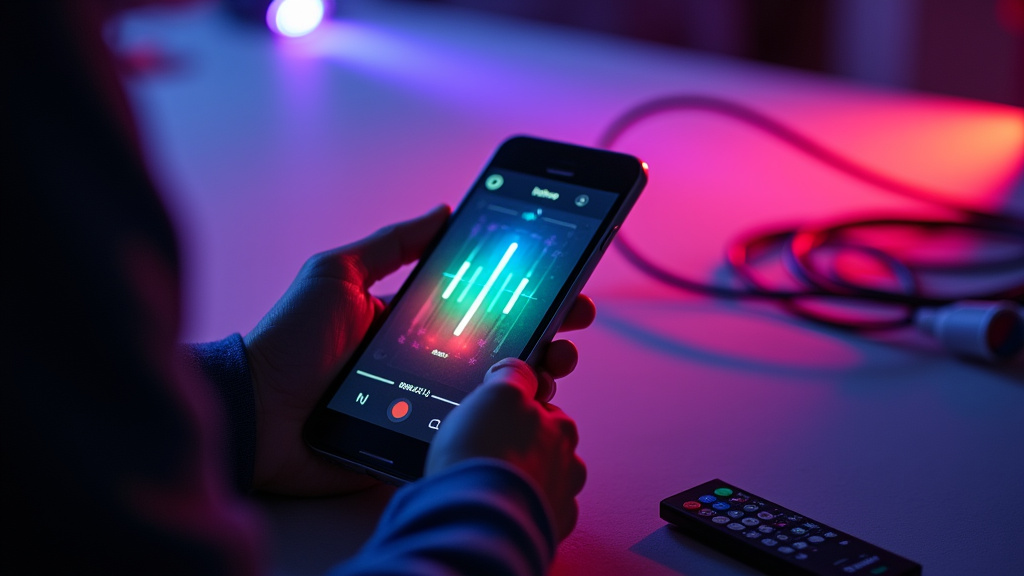
How you tell the lights what to do determines how often you’ll actually change them. A frustrating control system gets abandoned after five minutes.
Infrared Remotes are simple and universal. Point and click. They’re reliable but limited to the pre-set patterns and colors programmed into the light. You can’t create a custom scene that blends cyan and magenta at specific intensities. The range is also line-of-sight, step between the remote and the light’s receiver, and nothing happens.
Smartphone Apps (Govee Home, illumi Home) are the standard for mid-range and high-end lights. They connect via Wi-Fi or Bluetooth. This is where you unlock potential: creating, saving, and naming custom scenes. You can set schedules (lights on at 7 PM, off at 2 AM), adjust brightness and speed sliders with precision, and most importantly, enable true music sync.
Technical Snippet: App-based music sync uses your phone’s microphone to analyze audio frequencies. The app then maps bass beats to red flashes, mid-tones to color shifts, and treble to twinkle effects, sending these commands directly to the light over your local network. This allows for more nuanced reactions than a simple on-board mic.
DMX Control is the professional standard. DMX512 is a digital protocol that uses a cable (or wireless adapter) to daisy-chain up to 512 lights, each with a unique address. A DMX controller or software lets you program intricate sequences: light A fades to blue over 5 seconds while light B strobes white in time with a specific song cue. This is for permanent installations, wedding DJs, and club setups. It’s overkill for a living room party but essential for a repeatable, professional show.
| Control Method | Best For | Key Limitation |
|---|---|---|
| Infrared Remote | Simple setups, older guests, backup control | No custom scenes, line-of-sight only, limited patterns. |
| Smartphone App | Most home users, custom scenes, music sync | Requires phone battery, can have connection lag. |
| DMX Controller | Professional events, synchronized multi-light shows | Steep learning curve, requires cabling and addressing. |
TL;DR: For home use, an app-controlled light is the sweet spot. It balances simplicity with deep customization. Keep the physical remote as a handy backup.
Sound Activation: Built-In Mic or App-Only?
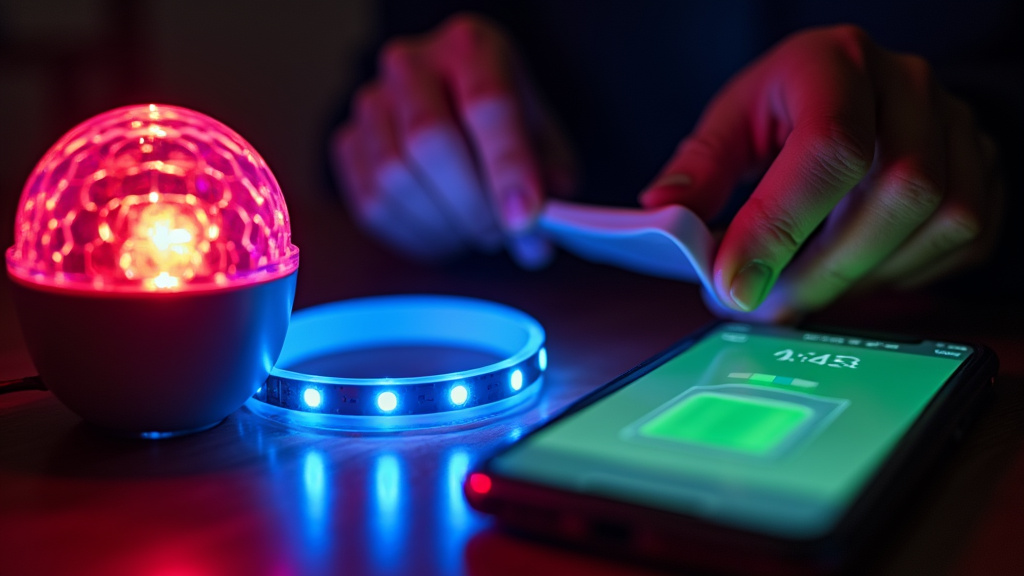
“Sound activation” on a product listing can mean two completely different things. One works automatically. The other ties you to your phone.
Lights with a built-in microphone analyze the room’s audio themselves. You plug in the Nequare Disco Ball, switch it to sound mode, and it starts reacting to the music. No phone needed. The sensitivity is usually adjustable via a knob on the unit or its remote. This is foolproof and reliable, the light is a self-contained system.
Lights that rely on app-based sound sync use your smartphone’s mic as the input. The Govee RGBIC Pro works this way. You must have the Govee Home app open and connected to the strip for the music mode to function. If you get a call, switch to a different app, or your phone locks, the sync stops. This allows for more advanced audio analysis but sacrifices autonomy.
I learned this the hard way setting up for a backyard party. I had two laser projectors listed as “sound-active.” One had a mic. The other required an app. Halfway through the night, my phone died. One laser kept dancing. The other froze on a static green pattern. The dance floor energy visibly dipped.
I won’t recommend an app-only sound-sync light as your primary effect for a long event. The built-in microphone is a set-and-forget feature that works from the first beat to the last call, regardless of your phone’s battery life.
If you’re creating a complex, multi-light scene programmed in an app, then app-based sync is part of the package. For a single plug-and-play effect light, a built-in mic is non-negotiable.
Power and Placement: Don’t Get Stranded in the Dark
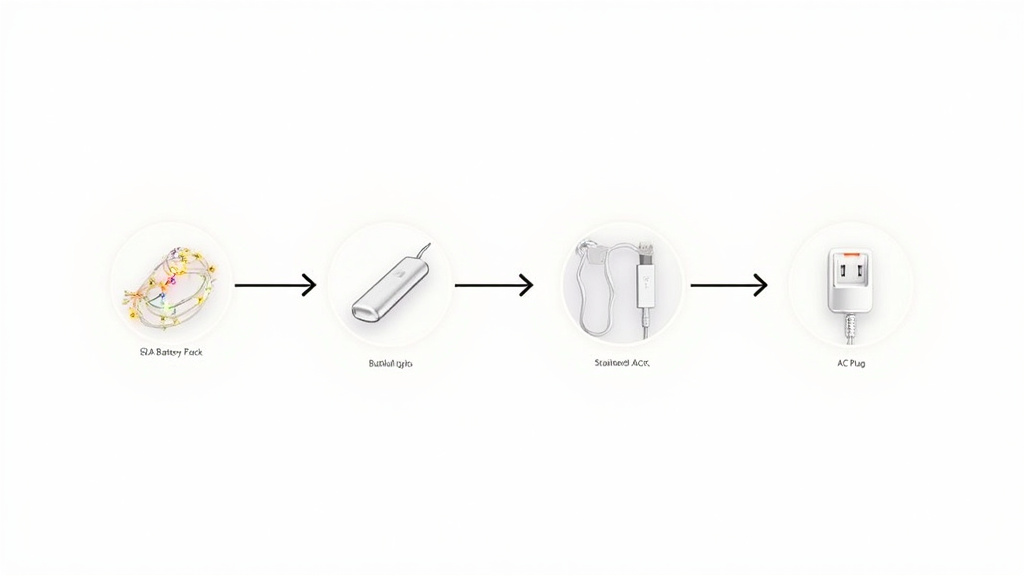
The best light is useless if you can’t plug it in or it dies in an hour. Power source dictates placement and flexibility.
Battery-Operated lights, like many fairy light strings, offer ultimate portability. No cords to trip over. The trade-off is runtime and brightness. A set of AA batteries might last 8 hours on a steady glow but only 3 on a dynamic twinkle mode. They also rarely have the output to serve as primary wash lighting.
USB-Powered lights are a great middle ground. You can power them from a portable power bank, a laptop, or a wall adapter. This gives you placement options away from outlets. Many modern LED strips and small projectors use USB. Just check the voltage, some require a 5V/2A adapter for full brightness and won’t work well on a low-output phone charger.
Wall-Plug (AC) lights are your workhorses for brightness and reliability. All high-output wash lights and effect projectors use this. You get constant, full power. The obvious constraint is the outlet. You’ll need extension cords and cable management. For outdoor use, you must use a GFCI-protected outlet and weatherproof cord connections.
Weatherproofing is rated by IP (Ingress Protection). For outdoors, look for IP65. The “6” means totally dust-tight. The “5” means it can handle low-pressure water jets from any direction. IP44 is only splash-resistant from a specific angle and won’t protect the electronics from morning dew or a driven rain.
The 10 Best Party Lights for Every Budget and Vibe
Here are the models that deliver on their promises, sorted by their primary role in your setup. Prices fluctuate, but the performance specs listed are stable.
1. For Smart Wash Lighting: Govee RGBIC Pro Wi-Fi LED Strip
This is the foundation for a modern, app-controlled party. The 16.4-foot strip uses RGBIC LEDs for segment-by-segment control. Connect it to the Govee Home app via Wi-Fi for access to millions of colors, custom scenes, and music sync that uses your phone’s mic. You can also schedule it and link it to Alexa or Google Home. The adhesive backing is strong, but wipe the surface with alcohol first.
Why it wins: The app scene library is massive. You can find a user-created scene for literally any holiday or music genre. The RGBIC implementation is smooth, with no visible segmentation between colors.
2. For a Classic Disco Effect: Nequare RGB Disco Ball Light
This isn’t your grandma’s mirror ball. It combines a rotating mirrored ball with a base that projects multi-colored LED patterns onto the ceiling and walls. It has a built-in microphone for sound activation, a remote, and several standalone auto modes. It’s plug-and-play perfect for a dance floor centerpiece.
Why it wins: The built-in mic is sensitive and responsive. It picks up bass well, making the light changes feel connected to the music without any setup.
3. For Laser Precision: Aomees 3-in-1 Party Laser Projector
This projector combines a green laser (most visible to the human eye) with red and blue LED stars and a rotating gobo pattern. It creates a dense, club-like atmosphere on your walls and ceiling. It includes sound activation, a timer, and a remote. The 105-degree beam angle ensures wide coverage.
Why it wins: The “3-in-1” effect adds depth. The laser draws sharp lines, the LEDs add twinkling points of light, and the gobo wheel projects shapes like flowers and snowflakes. It fills a room by itself.
4. For Delicate Accents: Etopgo 33ft Copper Wire Fairy Lights
These are pure accent lighting. The copper wires are thin, flexible, and nearly invisible when the 100 warm white LEDs are off. They’re battery-operated (requires 3 AA batteries, not included) with a timer function (6 hours on, 18 hours off). Use them to wrap banisters, drape over curtains, or weave into a centerpiece.
Why it wins: The wire is truly bendable and holds its shape. You can form letters or intricate designs. The warm white light is gentle and flattering, not the harsh cool white of cheaper fairy lights.
5. For TV Backlighting & Ambiance: Sengled Smart Light Strip
A more affordable alternative to Govee for basic RGB (not RGBIC) smart lighting. It connects via Wi-Fi and works with Alexa and Google Home. It’s a great choice if you want voice-controlled color for a media area or behind a bar and don’t need the advanced segment effects of RGBIC.
Why it wins: Simple setup, reliable app, and often priced lower than segment-controlled competitors. It’s a solid, no-fuss smart wash light.
6. For Professional Color Mixing: Chauvet DJ SlimPAR 56 USB
This is a pro-grade, DMX-capable LED wash light. It uses high-output LEDs with true color mixing (like an RGBIC strip on steroids) to create any shade. It can be controlled via DMX, its own built-in programs, or sound activation. It’s AC-powered and built for durability.
Why it wins: The color saturation and output are in a different league than consumer strips. It’s for someone who wants studio-quality light and is willing to learn basic DMX or use the robust standalone programs.
7. For Outdoor Durability: LE LED Strip Lights (IP67)
If you need to line a patio, deck, or pool area, this IP67-rated strip is built for it. The “7” means it can withstand temporary immersion in water. It’s a standard RGB strip with a remote, not a smart light. The silicone coating protects the LEDs from weather and UV damage.
Why it wins: It’s a tough, simple solution for permanent or semi-permanent outdoor color. The adhesive is industrial-strength and designed for outdoor surfaces.
8. For Portable Plug-and-Play: Lixada Mini Laser Light
A tiny, USB-powered laser projector. Plug it into a power bank, and it throws a kaleidoscope of red and green laser patterns. It has sound activation and auto modes. Its small size makes it perfect for tabletops, shelves, or small rooms where a larger projector is overkill.
Why it wins: Incredibly portable and low-profile. You can hide it among decorations. The USB power means you can run it from anywhere.
9. For a Retro Vibe: Brightech Ambience Pro String Lights
These are commercial-grade Edison bulb string lights. They provide warm, ambient white light, not colored effects. The 48-foot cord with 15 bulbs is perfect for patios, backyards, or indoor spaces where you want a cozy, inviting glow rather than a rave atmosphere.
Why it wins: Build quality. The bulbs are shatter-resistant, the cord is thick, and the plug is heavy-duty. They look good and will last for years of parties.
10. For Budget Sound Activation: Innoo Tech Disco Stage Light
A compact, all-in-one effect light. It projects rotating red, green, and blue patterns with a motorized lens. It has a strong built-in microphone for sound activation and a simple remote. It’s the cheapest way to get a dynamic, music-reactive light show in a small package.
Why it wins: Pure value. For under twenty dollars, you get a responsive, fun effect light that works right out of the box.
How to Layer Lights Like a Pro: A Step-by-Step Method
Throwing lights randomly at a wall looks chaotic. Follow this sequence to build a scene with intention.
- Anchor with Wash Lights. Install your primary LED strips first. Place them in locations that will bathe the largest walls or the ceiling in your base color. For a cohesive look, use the same color or gradient across all wash lights. This is your canvas.
- Add Primary Effect Lights. Position your disco ball or main laser projector to hit the central dance floor or most prominent wall. Turn it on and select a sound-activated or dynamic auto mode. This establishes the focal point of movement.
- Fill with Secondary Effects. Add smaller lasers, pinspots, or a second effect light at a different angle. This fills in shadows and creates visual depth. Avoid having all effect lights pointing the same way.
- Weave in Accent Lighting. Drape fairy lights, place battery-operated tea lights on tables, or use a pinspot to highlight a specific decoration (like a cake or speaker setup). This draws the eye to details and makes the space feel curated.
- Sync and Test. If using app control, group all lights in the app and select a master music sync mode. Play a track with a strong beat and walk the entire room. Look for dark spots or overly bright areas. Adjust angles and brightness sliders accordingly.
Common mistake: Turning all lights to maximum brightness and fastest speed, this creates sensory overload and looks frantic. The human eye needs areas of rest. Use slower speeds for ambient moments and reserve the fast strobes for peak dance tracks.
TL;DR: Start with a color wash, add a main moving effect, fill gaps with secondary effects, detail with accents, then fine-tune brightness and speed from the back of the room.
Frequently Asked Questions
What’s the difference between party lights and regular lights?
Party lights are designed for dynamic effects, color control, and synchronization with music or other lights. Regular lights are for general illumination. Party lights have features like sound activation, remote/app control, and the ability to produce colors and patterns beyond simple white light.
Can I use indoor party lights outside?
Only if they have a weatherproof rating, typically IP65 or higher. Using indoor lights outside exposes them to moisture and dust, which can cause electrical shorts, corrosion, and failure. Always check the IP rating on the product specifications before installing lights outdoors.
How many party lights do I need for my room?
good rule of thumb is one primary effect light (laser/disco ball) per 150 square feet of dance floor space, plus wash lighting around the perimeter. For a 12’x15′ room (180 sq ft), you’d want at least one main effect light and LED strips along two walls. For larger rooms, add more effects or increase the brightness/output of your wash lights.
Do all smart party lights work with Alexa and Google Home?
No. Compatibility must be explicitly stated. Lights that connect via a dedicated hub or a specific app (like Govee Home) will usually list their voice assistant compatibility. Lights controlled only by an infrared remote cannot connect to smart home systems.
Why are my sound-activated lights not reacting to the music?
Check three things. First, ensure the light is actually in sound-activated mode (not a static color mode). Second, adjust the microphone sensitivity, usually via a knob or in the app. Third, ensure the light’s built-in mic (or your phone’s mic if using app sync) isn’t obstructed or too far from the music source.
Is DMX control worth learning for home use?
For a single, occasional house party, no. The setup is complex. For someone who hosts frequent events, has a permanent home theater or bar setup, or wants absolute precision in multi-light choreography, learning basic DMX is a powerful skill. It turns your lights from decorations into a programmable show.
Before You Go
The right lighting transforms a gathering from a meeting in a room to an experience. Skip the basic, single-color strips. Invest in RGBIC for dynamic effects and prioritize lights with a built-in microphone for reliable sound activation. Start with a solid wash light as your foundation, layer in a central effect like a disco ball or laser, and use accent lights for the finishing touches. Control it all through a dedicated app to save your perfect scenes. With this approach, you’re not just buying bulbs, you’re buying atmosphere. Now go plug something in.