Are Dehumidifiers Safe to Leave On? Safety Rules & Risks
This post contains affiliate links. As an Amazon Associate, we earn from qualifying purchases.
Yes, modern dehumidifiers are safe to leave on, including overnight or while you’re away, provided they have specific safety features and you follow a strict setup checklist. The mandatory features are an automatic shut-off for a full water tank and a functioning humidistat. Without these, leaving the unit unattended risks water damage, electrical fire from an overheat, or severely over-dried air that damages wood and irritates lungs.
Most people assume any dehumidifier with an “auto” setting is safe for unattended use. They plug it in, set a humidity level, and walk away. The problem isn’t the intention, it’s the three hidden failures that happen between week one and week three: a clogged filter the user forgot to clean, a drain hose that kinked overnight, or a humidistat that drifted five percent out of calibration. Each one turns a safety feature into a liability.
This guide covers the five non-negotiable rules for safe continuous operation, explains why a constantly running unit is often a symptom of a different problem, and provides the troubleshooting steps I use when a dehumidifier in a client’s basement won’t cycle off.
Key Takeaways
- Never leave a dehumidifier unattended without a verified automatic shut-off and a humidistat. These two features prevent 90% of water and over-drying incidents.
- Continuous drainage via a hose is mandatory for vacations or multi-day absences. Relying on the internal tank, even with auto shut-off, invites a single-point failure.
- Clean the air filter every two weeks without exception. A clogged filter forces the compressor to overwork, raising internal temperatures and tripping thermal cutoffs, or worse, melting internal wiring insulation over months.
- Place the unit on a stable, level surface with two feet of clearance on all sides. Restricting airflow is the fastest way to burn out the fan motor and void the warranty.
- If the dehumidifier runs constantly without lowering humidity, you have an air leak, an undersized unit, or a failed humidistat. Adding a second dehumidifier without diagnosing this is a waste of $300.
What Makes a Dehumidifier Safe to Leave On?
Safety for unattended operation hinges on two engineered features and one user habit. The first feature is the bucket-full auto shut-off, a float switch that kills power to the compressor and fan when the internal tank reaches capacity. The second is the humidistat, a sensor and relay that cycles the unit on and off to maintain a set relative humidity, usually between 30% and 60%. The user habit is the maintenance schedule printed on a sticker most people peel off.
A modern refrigerant dehumidifier’s automatic shut-off uses a plastic float that rises with the water level. At the full point, the float magnetically trips a reed switch inside the control board, breaking the circuit to the compressor. This is a simple, binary safety, if the float jams on debris or the switch fails, the unit will overflow.
I learned the hard way that “auto” doesn’t mean “set and forget.” A few summers ago, I left a reputable brand’s 50-pint model running in a basement utility room while on a week-long trip. It had auto shut-off and a drain hose. What it didn’t have was a clean filter. The clogged filter caused the unit to overheat and shut down on thermal overload after two days. The basement humidity spiked back to 70%, and the musty smell had seeped into stored boxes by the time I returned. The unit was fine after cooling down, but the damage was done. Now I photograph the clean filter next to the unit’s serial number before any extended absence.
TL;DR: The shut-off stops floods, the humidistat stops over-drying, and your maintenance prevents fires. All three must work.
The 5 Non-Negotiable Rules for Safe, Unattended Use
Follow this list in order. Skipping step two because the outlet looks fine is how you end up with a tripped breaker at 3 a.m.
- Confirm Automatic Shut-Off and Humidistat Function. Test the shut-off by filling the tank until the unit powers down. Listen for the click. Test the humidistat by setting it 10% above the current room humidity, the unit should not start. Then set it 10% below, it should start within a minute.
- Inspect the Power Source and Cord. Plug the dehumidifier directly into a grounded wall outlet. Do not use an extension cord or a power strip shared with other appliances. Examine the entire length of the power cord for cracks, especially near the plug and where it enters the unit. Use a non-contact voltage tester to confirm the outlet is properly grounded if you have any doubt.
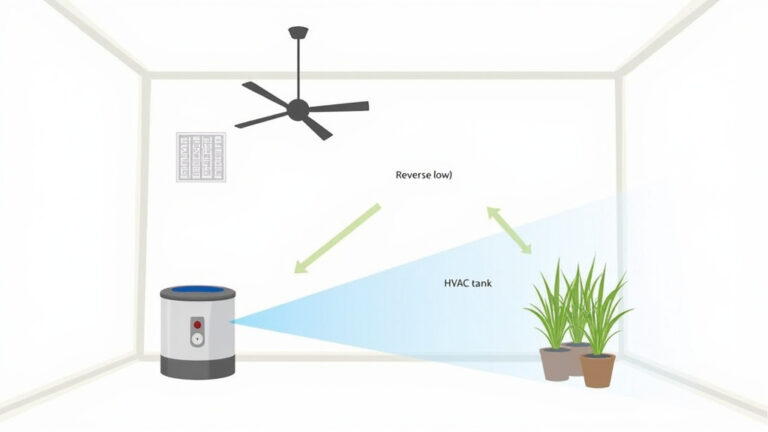
- Establish Proper Placement and Clearance. The unit must sit on a stable, level floor, not on carpet, a shelf, or a wobbly table. Provide at least 24 inches of clearance from walls, furniture, and curtains on all sides, especially the air intake and exhaust grilles. This airflow is what carries heat away from the condenser coil.
- Set Up Continuous Drainage or Verify the Tank. For any absence longer than 24 hours, use the continuous drain hose port. Attach a standard vinyl hose and run it to a floor drain, sump pit, or utility sink. Ensure the hose has a steady, downward slope with no kinks or loops that can trap air and block flow. If using the internal tank, empty it completely and ensure it clicks firmly into place.
- Perform a Pre-Operation Maintenance Check. Remove and rinse the air filter under warm water. Let it air-dry completely before reinserting. Wipe the empty water reservoir with a 1:10 vinegar-water solution to disinfect and prevent slime mold. Check the owner’s manual for the filter type; a pleated MERV 8 filter needs replacement every six months, not cleaning.
Common mistake: Using an extension cord for a dehumidifier, the sustained high current (often 7-10 amps) overheats lighter-gauge cord wire, melting the insulation near the plug within two weeks of continuous use. This is a leading cause of preventable electrical fires.
The consequences of skipping these rules aren’t always immediate. A unit placed too close to a curtain might run for a month before the reduced airflow causes the compressor thermal protector to fail. By then, the warranty is void.
Understanding the Real Risks of Leaving It On
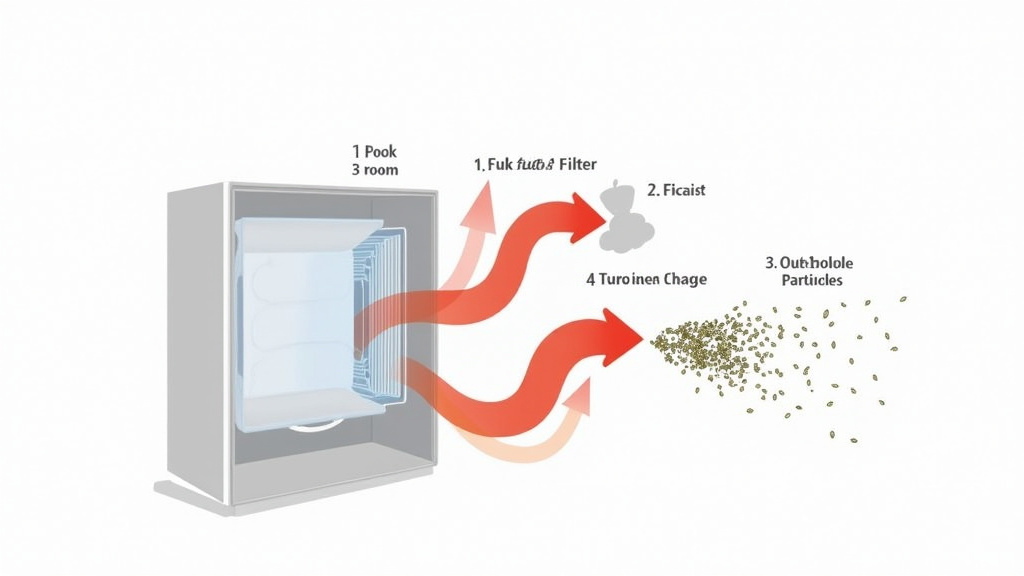
The risks boil down to four categories: fire, water, air, and money. Competitors mention them but rarely link the cause to a specific component failure you can check.
| Risk Category | Primary Cause | Likely Timeline | Prevention |
|---|---|---|---|
| Fire Hazard | Clogged filter + obstructed airflow overheating compressor | 2–4 weeks of neglected use | Bi-weekly filter cleaning + 24-inch clearance |
| Water Damage | Failed float switch or kinked drain hose | Can occur on first unattended cycle | Test shut-off; use rigid hose with downward slope |
| Poor Air Quality | Mold/bacteria in dirty water tank blowing into air stream | 1 week of stagnant water | Weekly tank wipe with vinegar solution |
| Over-Drying & Damage | Humidistat calibration drift or incorrect setting | Gradual over 2–3 months | Calibrate with a standalone hygrometer; set to 45–50% RH |
Electrical safety concerns like tripping a circuit breaker often stem from sharing an outlet with another high-draw appliance, not a faulty dehumidifier. The compressor’s startup amperage can be triple its running draw, which instantly overloads a 15-amp circuit already powering a freezer.
The mold risk from a dirty tank is real. The fan pulls room air across a cold evaporator coil, condensing moisture. That air then passes by the full water reservoir. If the tank has a biofilm of Aspergillus or other spores, the fan can aerosolize them back into the room. You’re not just dehumidifying; you’re contaminating.
Refrigerant vs. Desiccant: Which Is Safer for 24/7 Use?
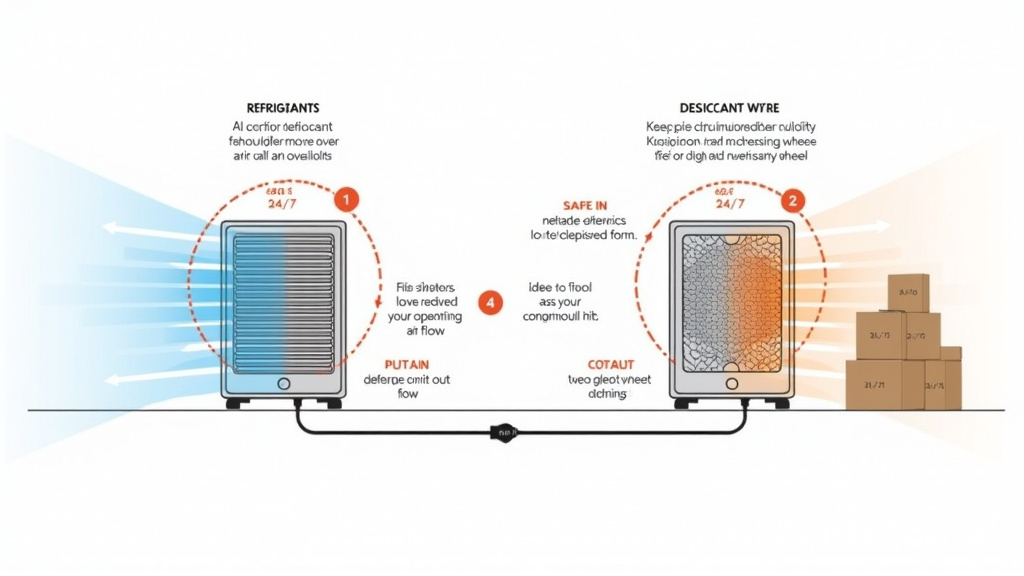
The two main dehumidifier technologies behave differently under continuous load. Your choice here affects safety margins and energy bills.
Refrigerant (Compressor-Based) Dehumidifiers are the most common. They work like an air conditioner, using a compressor and cold coil to condense moisture from the air. They are most efficient in warm, humid conditions (above 65°F). For continuous use, their safety hinges on the auto-defrost cycle. In cooler spaces, the evaporator coil can ice over, blocking airflow. A good auto-defrost cycle temporarily reverses the refrigerant flow to melt the ice. A unit without this feature will ice up and overheat.
Desiccant (Absorption) Dehumidifiers use a moisture-absorbing wheel and a heater to reactivate the desiccant material. They work well in cooler temperatures and typically have simpler mechanics, no compressor, no refrigerant. The primary safety concern is the heating element, which can reach 150–200°F. They require even stricter clearance from combustibles and have a higher energy cost per pint of water removed.
I prefer a refrigerant model with a confirmed auto-defrost cycle for a basement that stays above 60°F. The compressor is a known entity. For a crawl space or cool cellar that dips into the 50s, a desiccant unit avoids the icing problem entirely, but you must be fanatical about keeping anything flammable away from its exhaust vent.
For sizing a dehumidifier correctly, remember that an undersized unit will run constantly, stressing components. A 50-pint unit in a 1,500 sq ft damp area is a recipe for an early motor burnout.
Troubleshooting a Dehumidifier That Never Stops
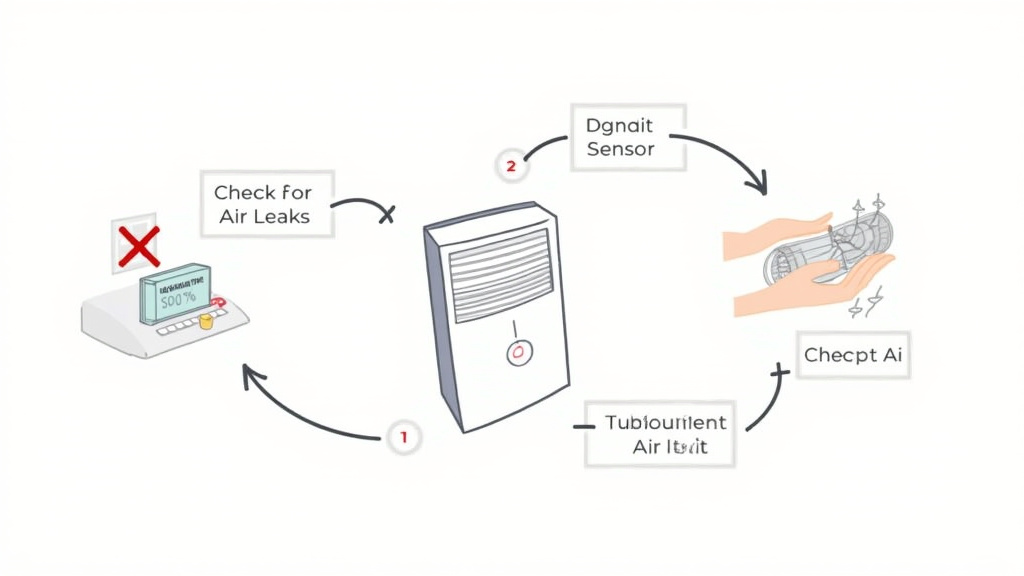
A dehumidifier that runs continuously without lowering the humidity has a problem. It’s not just inefficient; it’s wearing out its major components. Here’s the diagnostic sequence I follow.
First, verify the room’s actual humidity with a standalone digital hygrometer. Place it a few feet from the dehumidifier. If the hygrometer reads 50% but the dehumidifier’s display says 70%, the internal humidistat is miscalibrated. You’ll need to adjust it per the manual or rely on the external hygrometer to control the unit manually.
Second, check for air exchange. Is there an open window, an unsealed dryer vent, or a door to a more humid space left ajar? The dehumidifier can only process the air in the sealed space it’s in. It will run forever trying to dry out the entire neighborhood.
Third, feel the air coming out of the unit. It should be noticeably warmer and drier than the room air. If it’s cool or room-temperature, the compressor may not be engaging. This could be a failed start capacitor, a locked rotor, or a refrigerant leak. These are repair-shop issues.
If all checks pass, the unit is likely undersized for the moisture load. This is common in basements after heavy rain or in rooms with many plants. Using an air purifier simultaneously won’t help this, you need either a larger dehumidifier or a second unit placed strategically to create a drying zone.
Common mistake: Cranking the humidistat to the lowest setting (30%), this forces the unit to chase an unrealistic target in a naturally damp space, causing non-stop operation, high energy bills, and over-dried air that cracks wood trim and plaster within a season.
TL;DR: Constant running means one of three things: bad sensor, outside air leaking in, or not enough machine for the job. Fix the leak first.
The Environmental and Cost Impact of 24/7 Operation
Leaving a dehumidifier on continuously has a tangible footprint. A typical 50-pint refrigerant dehumidifier draws about 500 watts. Running it 24/7 for a month consumes roughly 360 kilowatt-hours. At the U.S. average of 16 cents per kWh, that’s nearly $60 added to your utility bill. A desiccant model can draw 700 watts or more, pushing the cost over $80 monthly.
Beyond the cost, that’s 360 kWh of grid demand, largely from fossil fuels in most regions. It’s the equivalent of burning about 250 pounds of coal. This isn’t to scare you off necessary moisture control, a mold remediation costs thousands and has its own environmental toll. It’s to emphasize that correct setting humidity levels to a reasonable 50% and sealing air leaks can reduce runtime by half or more.
For seasonal humidifier use, the opposite is true; you turn it off when ambient humidity is high. The principle is the same: run appliances only when they are solving a verified problem, not on a default calendar schedule.
Frequently Asked Questions
Can I leave a dehumidifier on all night in my bedroom?
Yes, if the noise doesn’t disturb you. Modern units are safe for overnight use. For a bedroom, prioritize a model marketed as “quiet” (often under 50 decibels) and ensure it has all the safety features. Proper bedroom appliance placement means keeping it at least three feet from the bed to avoid direct airflow and any potential tripping hazard from the cord.
How long can I safely leave a dehumidifier running?
You can leave a properly maintained dehumidifier with a drain hose running indefinitely. The limiting factors are filter cleanliness and component wear. Plan to clean the filter every two weeks and inspect the unit monthly for unusual vibrations or sounds. Without a drain hose, runtime is limited by the tank size and the reliability of the auto shut-off.
Will a dehumidifier stop automatically when the room is dry?
Only if it has a functioning humidistat. The unit will run until either the humidistat senses the target humidity is reached and cycles it off, or the water tank fills and triggers the automatic shut-off. If it lacks a humidistat, it will run until the tank is full or you turn it off manually.
Is it safe to leave a dehumidifier on while on vacation?
Yes, but with strict prerequisites. You must use a continuous drain hose routed to a reliable drain. You must clean the filter and tank immediately before leaving. You should also consider plugging the unit into a smart plug that allows remote monitoring and shut-off, providing a backup safety layer in case of a problem.
Can a dehumidifier overheat and cause a fire?
Any electrical appliance with a motor and heating elements can overheat. For dehumidifiers, the primary causes are blocked air filters, obstructed vents, or a failing fan motor. These conditions cause heat to build up around the compressor or wiring. Modern units have thermal overload protectors that should cut power before a fire starts, but these are last-resort safeguards, not substitutes for maintenance.
Before You Go
Leaving a dehumidifier on is a matter of verified safety features, not guesswork. The automatic shut-off and humidistat are your frontline defenders against floods and over-drying. Your discipline with the filter and drain hose is what prevents the slow-moving failures that turn a helpful appliance into a hazard.
Don’t just set it and forget it. Set it, test the shut-off, clean the filter, and run the drain hose. That sequence takes ten minutes. It’s cheaper than a service call, a water-damaged floor, or a sleepless night listening for a strange click from the basement. Control the moisture, but respect the machine doing the work.