Fog machines are devices used by entertainers, trainers, and the military to produce artificial vapors that resemble fog. There are different varieties depending on the intended effect. Its mechanism is quite basic: vapor is produced by mixing and heating water with glycol, glycerin or oil. The steam that comes out looks like actual fog. Once the vapors exit the machine, they condense and become visible to people.
Some people believe these machines have their drawbacks mainly because the fluids they run on may be irritating or even allergenic for some people. However, there are many different manufacturers to buy these products from so it’s really up to each person whether to buy good or bad quality liquids. In addition, fog machines require certain maintenance as, for example, the heat exchanger tends to clog and it needs to be cleaned on a daily basis.
The best thing about fog machines is that they come in all sizes to produce from a minimum haze to heaps of fog. They are easy to carry around (not heavy) and the fluids can be ordered through the mail and store indefinitely. So don’t worry if you don’t have use for all the fluids you bought, you can store them and use them on another occasion. Plus, they are very cheap. Let’s take a look at the best machine fog fluid to make the most out of your party.
Top 5 Fog Machine Fluid Available Today
- Sanco Industries FogWorx Extreme High Density Fog Juice
- Froggys Fog – Beam Splitter – Professional Water Based Haze Fluid
- Essential Values Fog Machine Fluid
- Froggys Fog Juice for Water Based Fog Machines
- CHAUVET DJ High Performance Haze Fluid (HFG)
- Code 6 Platinum Fog Machine Fluid
Main features of Fog Machines and its Fluid
The main components of fog machines are:
- The fog fluid that is placed in the fluid tank and goes through the heat exchanger to be turned into vapor. It is a mixture of water and glycol.
- The pump that is necessary to transport the fog fluid from the tank to the heat exchanger.
- The Nozzle which would be the hot opening through which the vapor exits.
- The heat exchanger that regulates the temperature inside.
- A remote control to control from a distance the different effects, amount and density of the fog.
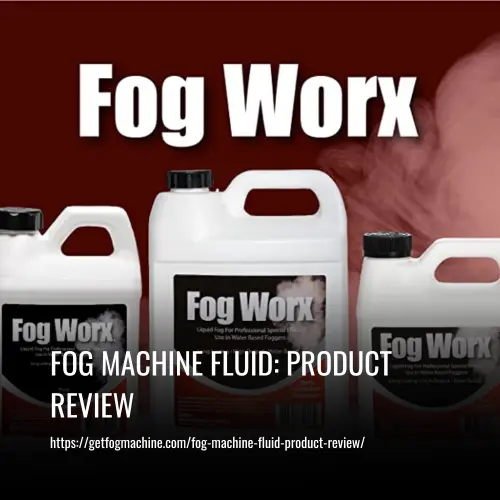
1. FogWorx Fog Machine Fluid
The FogWork Fog Machine Fluid is completely water-based, which means that it does not smell, make a mess or dampen anything. Also, thanks to its high-density formula, the fog disperses all through the room and stays there for a long time.
All its premium chemicals are FDA-approved, so there is nothing you should worry about. They are also environmentally friendly, as they are all made with organic materials. It is perfect for all types of parties, from night clubs to laser tag arenas.
The best part is that does not require a lot of power to work, as it functions perfectly well even with 400-watt machines. What is more, with only one gallon of water, you can get up to 128 ounces of fog. With this fog machine fluid, turn an average party into an unforgettable one!
Pros
- It’s high density but vaporizes at lower temperatures.
- It does not leave any residue.
- Excellent hang time.
- No weird smells.
- Same-day shipping available.
Cons
- There are some cheaper options.
- Size could be a bit small.
All in all, the FogWork Fog Machine Fluid is one of the best in the market. It offers a hassle-free experience for those who are looking to have some fun and throw an awsome party without having to be experts. Yet, those who do this professionally will also benefit from all of the features that this product has to offer.
While most other fogs tend to smell and leave resides, this one does not. It provides a completely clean experience. And most importantly, it does not dissipate fast. So, if you need the perfect fog fluid for your party, look no further!
2. Code 6 Platinum Fog Machine Fluid
As stated before, it’s very important to choose a quality fluid for the fog machine to really serve its purpose. Code 6 Platinum, then, can be a great ally in throwing the best party ever. It’s high-density fog that will keep your guests entertained without irritating their eyes. It will remain clean and dry for as long as you need it to be. It has 3 hours hang-time, which is great for a product of this affordable pricing. Another great feature that all quality fluid should contain is being odorless and non-toxic. Nobody wants to poison their guests, right?
Another feature you will surely appreciate is it is non-flammable. In a party, there is always some risk of accident or even of a fire. You should not expose yourself or your guests as long as you can, so it’s crucial that this company only uses de-ionized water and top-notch chemicals to manufacture their fluid. Of course, it has been approved by the FDA.
Pros
- Safe for your use, as it has passed any test that the FDA asked for.
- The time and process of preparation are not long or hard.
- It does not have a foul smell and is protected against fire.
- Very affordable
Cons
- It’s not very suitable for outdoors, yet it still works.
If you think that your fog machine is not working properly, it might be because you are not using a high-quality fluid as fuel. The fog should be thick, even if you are in an open space. This product hangs around for quite some time in a nice, dense cloud of smoke that will remain with you for a long time to enjoy the dance.
On the downsides, it might be a bit fickle, meaning that if there is some kind of wind, then the fog can dissipate. All in all, it is a good value for money, and their competitors for the same pricing do not even come close to the quality fog that this produces.
Some Tips to buy the best Fog Machine and its Fluid
There are many things you need to take into account when shopping for a fog machine. And take this into account: it will only work as long as the fluid is appropriate and high quality!
1. Size: these machines come in a wide range of sizes and shapes according to every need.
2. Output: you have to bear in mind that some machines produce more fog than others. For example, some may stretch to a 2-meter distance, while others up to 8. If the space is too limited, it can be a problem.
3. Portability: people usually rent these machines or carry them to other locations. So, how much the machine weighs is important. If you buy a heavy machine, you will always need help carrying it around and you will also need a vehicle to transport it.
4. Noise: some machines are noisier than others. And the quality of the fog machine fluid can influence that. If the formula is not good for your machine, then it can break down. Be careful!
Why is it important to choose the best Fog machine?
Choosing the most adequate fog machine is really important. There are so many options in the market that one may get confused and think they are all similar. That’s why it is important that you follow these tips and buy the best fog machine. Remember: size, output, portability and noise, and crucial factors to bear in mind.
Plus, the quality of the materials that these machines are made of and the fluid you are going to use. Not all the juice will have the job done: take a close look at the one you need, and don’t be afraid of spending what that’s worth!