Snow Making Machine Cost | Price Guide & Hidden Expenses

This post contains affiliate links. As an Amazon Associate, we earn from qualifying purchases.

A snow making machine costs between $35 for a small party-effect unit and over $275,000 for a fully automatic industrial system producing 25 cubic meters of snow daily. The price you pay is dictated by three things: daily snow output (kg or m³), intended use (residential, commercial, resort), and whether the quoted price includes refrigerant, warranty, and remote monitoring.

Most buyers fixate on the first number, the purchase price. They scroll Amazon, see a $90 machine, and think the job is done. The real budget shock hits six months later when the electric bill arrives or the first service call costs more than the machine itself.

This guide maps the entire cost landscape. You’ll see exact price brackets for every use case, learn which operating expenses trip up first-time buyers, and get a clear method to compare total cost of ownership, not just sticker prices.

Key Takeaways

  • Purchase prices span five orders of magnitude. A $50 party machine and a $50,000 snow gun are different species. Match output to need.
  • Operating costs often dwarf the purchase price. For commercial machines, annual energy, maintenance, and fluid can add $10,000–$50,000+ per season.
  • Always ask what’s included. Some commercial quotes bundle refrigerant, a 3-year warranty, and remote monitoring. Others charge extra for each.
  • Renting is a viable shortcut. Weekly rentals start around £110, letting you test a machine’s output and operating cost before a five-figure commitment.
  • DIY and fluid are hidden budget lines. Building a machine costs $85–$250 in parts, and specialized snow fluid runs $20–$40 per bottle, consumed in hours.

The Snow Machine Price Spectrum: From Party Trick to Mountain Builder

Head design changes the entire process. Look at the business end of your trimmer.

The price tag on a snow machine tells you its job description. Confuse the categories and you either waste money on overkill or burn out a toy trying to do a pro’s work.

A commercial snow-making machine from manufacturers like Latitude 90 includes branding customization, refrigerant, first-year maintenance materials, a three-year warranty, and one year of remote monitoring services in its purchase price. This bundled approach shifts the cost from a simple equipment purchase to a managed solution.

Small Effect & Residential Machines ($35 – $800)

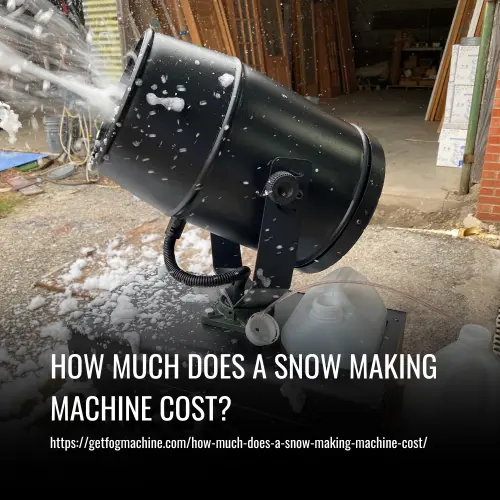
This is the “Amazon special” zone. Machines here, like the Snow 1800 or generic “snow jet” models, are designed for intermittent, short-duration use. They create a visual effect, not a skating rink.

You’ll typically get a plastic housing, a small fluid reservoir (1–2 quarts), and a basic fan. Output is measured in minutes of runtime per tank, not kilograms per day. The YouTube transcript shows a user mixing half an 8–ounce bottle of concentrate with about a quart of water for roughly 20 minutes of snow. That’s the scale.

These units are priced for convenience, not durability. Run one for more than an hour continuously and the motor will protest with a sharp, hot plastic smell. They are perfect for a Halloween walkway or a Christmas morning surprise under the tree. For anything more, look up.

Machine Type Price Range Best For Realistic Output
Party Effect $35 – $185 Indoor events, photo backdrops 15–30 min runtime per 1-quart tank
Home Display $100 – $400 Yard displays, small business attractions 20–45 min runtime, slightly larger tank
DIY Build $85 – $250 (parts) Hobbyists, custom projects Varies wildly; often higher fluid consumption

Commercial & Seasonal Business Machines ($500 – $22,000)

Here, snow becomes a product. These machines supply winter attractions, tubing hills, seasonal ice rinks, or event companies. Output is now measured in hundreds or thousands of kilograms per day.

A machine producing 2,000 kg/day might cost around $1,360. One rated for 4,500 kg/day can be in the $360 range for certain components, but a complete, reliable unit is more often $2,000–$5,000. This is where you start seeing metal construction, larger pumps, and proper thermal exchange systems.

The business model demands reliability. A single weekend of downtime during the holiday season can wipe out the profit margin. Brands like Bucceri Snow Making offer machines in this tier with clear daily output and power specs. You’re no longer buying a gadget; you’re buying a piece of seasonal infrastructure.

Industrial Ski Resort Snow Guns ($5,000 – $275,000+)

This is heavy industry. The metric is cubic meters per hour, and the goal is covering acres of mountainside with a consistent, packable snow base.

Lower-end resort guns producing 50–100 m³/hour range from $5,000 to $13,800. High-efficiency models designed to work at marginal wet-bulb temperatures can hit $21,500–$22,000. At the top, fully automatic systems from companies like Bucceri Snow Making run from $65,000 (for 6.25 m³/day) to $275,000 (for 25 m³/day).

The purchase is just the entry fee. Installation requires water lines, air compressors, electrical substations, and sometimes towers. The price per unit is high, but the cost per cubic meter of snow produced can be lower than a small machine running non-stop, it’s about scale and efficiency.

TL;DR: Price follows output. Party machines cost hundreds, business machines cost thousands, and mountain-makers cost hundreds of thousands. Buying one category for another’s job always loses money.

What Actually Determines the Sticker Price?

Wind direction decides whether the head feeds or jams. For snow machines, four engineering choices set the price before the first flake falls.

First, the heat exchange system. Cheap machines use a simple chilled plate. Expensive ones use a cascade refrigeration circuit or nucleator nozzles that atomize water under high pressure. The latter method produces a drier, more natural snow but requires compressed air and precise engineering. That’s a $15,000 difference right there.

Second, construction materials. A plastic blower housing might last two seasons of light use. A cast aluminum or stainless steel housing withstands years of commercial operation, freezing temperatures, and hauling. You pay for the metal upfront to avoid replacement costs later.

Third, automation and control. A manual on/off switch is fine for a party. A system with a PLC (Programmable Logic Controller), remote monitoring via cellular modem, and automatic shutdown based on ambient wet-bulb temperature is for a resort. Latitude 90 includes one year of this remote monitoring in their price, it’s a bundled service, not just hardware.

Common mistake: Comparing machines by price alone without checking the control system, a manual machine left running in rising temperatures wastes thousands in fluid and power within a day, while an automated one shuts down and saves the margin.

Fourth, and most critical, is the rated daily output. This number, in kilograms or cubic meters, is the engine of the price. Manufacturers know exactly how much snow a design can produce under standard conditions. They price accordingly.

A machine rated for 2,000 kg/day is a tool for a small seasonal business. One rated for 25 m³/day is for a ski resort covering multiple runs. The second machine doesn’t just cost more; it’s a different class of device with different auxiliary needs (water pressure, air supply, three-phase power).

When you see a surprisingly low price for a high-output claim, scrutinize the conditions. “Produces 4,500 kg/day” might be a theoretical maximum at -10°C with perfect water pressure, not an average under realistic operating conditions.

The Real Cost: What Happens After You Buy

Close-up of snow machine fluid concentrate bottle and purchase receipt on workbench.

The purchase receipt is the smallest financial document you’ll sign. Operating a snow machine is a continuous burn of cash for electricity, fluid, maintenance, and labor. Most first-time commercial buyers underestimate this layer by a factor of three.

Let’s break it down by machine category.

Small Machine Operating Costs

For a $90 party machine, the primary ongoing cost is specialized snow fluid. Using standard fog juice in a snow machine will damage the pump, you need the correct fluid. A four-pack of snow fluid concentrate can cost $80 ($20 per bottle). As the YouTube video shows, half a bottle (4 oz) mixed with water yields about 20 minutes of snow.

If your event runs three hours, you’ll need 1.5 bottles, about $30 in fluid just for that day. Over a season of weekend events, fluid can cost more than the machine. There’s also electricity, but it’s minor, these units plug into a standard outlet.

Commercial Machine Operating Costs

This is where the spreadsheet gets serious. Data from operational cost studies breaks it into four pillars.

  1. Energy Consumption: The biggest line item. A commercial machine can draw several kilowatts. Running it 12 hours a day for a 60-day season at $0.15 per kW/h adds up fast. One resort estimate puts the cost at $200–$1,000 per inch of artificial snow daily, depending on local electricity rates and system efficiency.
  2. Maintenance & Repairs: Annual maintenance for a commercial system runs $6,000–$10,000. This covers servicing pumps, replacing seals, cleaning heat exchangers, and repairing corrosion. Older systems cost more. Skip this maintenance and a $5,000 compressor failure will shut you down in peak season.
  3. Labor: You need someone to operate, monitor, and move the equipment. If it’s a ski patrol member also doing other duties, maybe $15–$30 per hour. If it’s a dedicated technician, it’s a full wage plus benefits.
  4. Fuel (for mobile systems): If you’re using a snowcat to move guns, fuel is a cost. A snowcat burns about 3.77 gallons of diesel per hour. At $4/gallon, that’s another $15 per hour of operation.

I learned the maintenance cost the hard way. We ran a mid-sized machine for a seasonal attraction for two winters without a professional service, just basic cleaning. In the third winter, the nucleator nozzle clogged with mineral scale from our hard water. The repair bill was $2,800, more than we’d saved by skipping the $500 annual service. Now the service contract is the first line in the seasonal budget.

Industrial Resort Operating Costs

At this scale, costs are measured in millions per season. Energy is the dominant factor, often requiring negotiations with the power company for seasonal rates. Water rights and pumping costs add another layer. Labor is a full team. Maintenance is a dedicated shop with a parts inventory.

The focus shifts from pure cost to cost per cubic meter of snow. A more expensive, high-efficiency gun that produces drier snow with less energy and water can have a lower operating cost per unit volume, justifying its higher purchase price through a quicker ROI.

TL;DR: The machine’s price is the ticket to the game. Electricity, fluid, repairs, and labor are the concession prices you pay every quarter. For commercial use, the concessions often cost more than the ticket.

To Buy, Rent, or Build? The Financial Crossroads

Hands holding a rental contract and keys for a snowmaking machine.

Your frequency of use dictates the smartest financial path. Buying a $5,000 machine for a one-week Christmas event is folly. Renting a machine for that week for a few hundred pounds makes sense.

Renting a Snow Machine

Rental houses stock commercial-grade machines for events, film shoots, and short-term installations. A weekly rental starts around £110. The rental typically includes the machine and sometimes an initial tank of fluid. You pay for additional fluid and your own electricity.

Renting is the ultimate test drive. It lets you experience the machine’s output, noise level, and fluid consumption on your site before writing a five-figure check. It also offloads maintenance responsibility, if it breaks, they replace it.

Building Your Own Machine

The DIY route appeals to tinkerers. Online plans use components like aquarium chillers, PVC pipe, and pond pumps. Parts cost $85–$250. The output is unpredictable, and reliability is zero. It’s a fun project, not a business tool.

The hidden cost here is time and safety. You’re mixing water, electricity, and refrigeration components. A leak or short circuit is a real risk. For a hobby display, it might be worth it. For any public-facing or revenue-generating use, it’s a liability.

Financing a Commercial Purchase

For a seasonal business, financing through a equipment lease or loan is common. The machine generates revenue, so payments are tied to its use. Some manufacturers work with financing partners. This turns a large capital outlay into a manageable operational expense.

The key is calculating the Return on Investment (ROI). A manufacturer like Latitude 90 advertises a quick ROI, potentially within one season, based on competitive pricing and low operating costs. Your calculation must include your projected ticket sales, rental fees, or increased attraction revenue against the total cost of ownership.

Common mistake: Financing the purchase price without modeling the operating costs, your loan payment might be $400/month, but your first month’s electric bill could be $600, strangling cash flow before the season even peaks.

Critical Questions Before You Spend Any Money

Checklist of critical questions to ask before buying a snow making machine

You wouldn’t buy a standard fog machine for a snowy effect. The same specificity applies to snow machines. Ask these questions before you get a quote.

What is the exact daily output under my local conditions?

Don’t accept the brochure’s ideal output. Ask for the output curve across a range of temperatures and humidity levels (wet-bulb temperatures). A machine that only works at -5°C is useless if your average winter night is -1°C.

What is included in the quoted price?

Is it just the gun? Or does it include the proprietary refrigerant charge, first-year maintenance kit, warranty, and remote monitoring? As noted, some manufacturers bundle these. If they’re extra, get those line-item prices upfront.

What are the auxiliary requirements?

Does the machine need a specific water pressure (e.g., 100 PSI)? Does it require a dedicated electrical circuit (220V, 30 Amp)? Does it need a compressed air supply? The cost to provide these utilities can exceed the machine cost if your site isn’t already equipped.

What is the fluid consumption rate and cost?

Get the milliliters of concentrate per minute of operation. Multiply that by your planned hours of use. Then find a supplier for that snow fluid and get a bulk price. Fluid is a consumable, not a one-time cost.

What does the warranty actually cover?

A “three-year warranty” might cover parts but not labor or shipping. It might be voided if you use a third-party fluid or don’t perform specific monthly maintenance. Read the terms. A robust warranty, like Latitude 90’s, adds real value to the purchase price.

Answering these questions moves you from shopping for a product to procuring a system. It’s the difference between a pleasant surprise and a budget catastrophe.

Frequently Asked Questions

Can I use a regular fog machine as a snow machine?

No. Fog machines heat a glycol-based fluid to create vapor. Snow machines chill a water-based fluid to create ice crystals. Putting snow fluid in a fog machine will damage the heating element and pump. Putting fog juice in a snow machine won’t create snow and may gunk up the chilling mechanism.

How long does a bottle of snow fluid last?

It depends on machine output. For a small party machine, a common 8-ounce bottle of concentrate, when diluted per instructions (e.g., 1:15 with water), can last 60–90 minutes of continuous operation. For a commercial machine, fluid is consumed by the liter per hour. Always check the machine’s spec sheet for its fluid consumption rate.

Are there cheap snow machines under $100 that work well?

Yes, for their intended purpose. Machines like the Snow 1800 or similar affordable fog machines analogues in the snow world are excellent for creating a 20–30 minute effect in a controlled space. They are not built for daily use, outdoor wind, or covering large areas. You get what you pay for.

How much does it cost to run a snow machine for 8 hours?

For a small machine: perhaps $2–$3 in electricity and $20–$40 in fluid. For a commercial machine: electricity could be $30–$80 (at 3–8 kW draw), plus $60–$150 in fluid, depending on the model. This is why understanding operating cost is as important as the purchase price.

Is it worth buying a commercial machine for a small business?

Only if snow is a core revenue driver for enough weeks per year to justify the total cost of ownership. Calculate your expected additional income from having snow, then subtract the purchase price (amortized over 5 years), plus the annual operating costs. If the number is positive over a realistic season, it’s an investment. If not, renting a portable fog machine for effects or sticking to a small display machine is smarter.

What’s the biggest hidden cost?

Energy. It’s the silent, ongoing drain that many first-time commercial buyers fail to model accurately. Request the machine’s power draw in kilowatts (kW) from the manufacturer, get your local cost per kW/h from the utility, and do the math for your planned operating hours. The result often shocks people.

Before You Go

The cost of a snow making machine isn’t a single number. It’s a layered equation: Purchase Price + (Energy + Fluid + Maintenance + Labor) x Seasons of Use.

For a backyard party, the equation is simple, a $90 machine plus $30 in fluid. For a ski resort, it’s a capital project with multi-year ROI calculations. The businesses that succeed are the ones that budget for the whole lifecycle, not just the shiny hardware.

Start with your output need. Then find machines that meet it. Then, and only then, compare their total cost of ownership. That final number, the one that includes the power bill you’ll pay every month, is the real price of making it snow.


Similar Posts