Will a Fog Machine Set Off Your Smoke Alarm? Prevention Tips
This post contains affiliate links. As an Amazon Associate, we earn from qualifying purchases.
Do fog machines set off smoke alarms? Yes, absolutely. They trigger specific types of detectors by filling the air with microscopic liquid particles that mimic the light-scattering properties of smoke. The risk depends entirely on the detector technology in your venue, the density of your fog, and where you place the machine.
Most people assume a venue’s fire system is a single, simple alarm. It’s not. You’re dealing with a network of sensors that each see the world differently. The wrong burst in the wrong room doesn’t just kill the mood, it summons trucks with flashing lights and can land you with a four-figure fine for a false alarm.
This guide breaks down exactly which alarms will scream at your fog, why they do it, and the field-tested tactics to run your effect without the sirens.
Key Takeaways
- Photoelectric smoke detectors are the primary culprit. They work by detecting scattered light from airborne particles, and theatrical fog particles (0.5–4 micrometers) are perfect for tripping them.
- Ionization and heat detectors are far less likely to trigger. Ionization units look for tiny particles from flaming fires; fog particles are too large. Heat detectors only react to a rapid temperature rise.
- Always test with the venue’s fire marshal present. A 5-minute low-output test with the alarms in “test” or “monitor” mode reveals the room’s specific sensitivity and airflow traps.
- Placement is your first line of defense. Keep the machine at least 10 feet from any detector and direct output sideways, not up. Fog rises; don’t help it.
- Haze machines are a lower-risk alternative for lighting effects. They produce a finer, more diffuse particle that hangs in the air longer but is less dense at the detector’s location.
The 3 Alarm Types That React Differently to Fog
Fire alarm systems are not a monolith. Each detector type uses a distinct physical principle, and your fog machine’s output is only a problem for some of them. Knowing which one is on the ceiling above your stage is step zero.
Photoelectric smoke detectors are your main adversary. Inside the unit, a small LED light beam shines across a chamber into a light sensor. When particles enter the chamber, they scatter the light onto a secondary sensor. Theatrical fog consists of glycol or glycerin droplets between 0.5 and 4 micrometers in diameter, precisely the size that scatters light most effectively. The detector reads this as smoke.
Photoelectric smoke detectors utilize a light‑scattering chamber sensitive to particles larger than 0.3 micrometers. Theatrical fog fluids, when vaporized, produce a dense aerosol of liquid droplets typically measuring 0.5 to 4 micrometers. This particle size falls within the detector’s optimal sensitivity range, causing it to interpret the dispersed light as a smoke signature and initiate an alarm.
Ionization smoke detectors are far less likely to cause trouble. These have a tiny radioactive source that ionizes air molecules in a chamber, creating a small, steady electrical current. When very small particles from fast, flaming fires enter, they disrupt this current. The particles from a fog machine are generally too large to interfere significantly. You might get a false alarm if you flood the detector chamber directly with an extremely dense cloud, but at normal atmospheric densities, ionization detectors usually stay quiet.
Heat detectors and carbon monoxide (CO) alarms are generally safe. Heat detectors, common in warehouses and kitchens, only trigger at a fixed temperature (e.g., 136°F/58°C) or a rapid rate-of-rise. Your fog machine’s output is ambient temperature. CO alarms look for a specific gas molecule and ignore particulate matter entirely.
| Detector Type | How It Works | Risk from Fog | Common Location |
|---|---|---|---|
| Photoelectric | Scatters light beam with particles | Very High | Hallways, theaters, most commercial spaces |
| Ionization | Disrupts electrical current with particles | Low | Residential bedrooms, older buildings |
| Heat Detector | Senses temperature rise | None | Kitchens, garages, industrial spaces |
| CO Alarm | Detects carbon monoxide gas | None | Near fuel-burning appliances |
TL;DR: Find the photoelectric detectors, they’re the ones that will go off. Look for a unit with a honeycomb-like chamber on its face.
Fog vs. Haze vs. Dry Ice: Not All “Smoke” Is Equal
The word “fog” gets tossed around for all atmospheric effects, but the machine you choose changes the game. Your decision here is the single biggest factor in alarm risk, second only to detector type.
A fog machine uses a pump to push fluid (typically a water and glycol mix) across a heating element, creating a dense, quick-dissipating vapor. It’s for dramatic bursts, a haunted house jump-scare, a concert intro. That density is what photoelectric detectors see. The internal heating element vaporizes the fluid in seconds.
A haze machine is a different beast. It produces a finer, drier aerosol designed to hang in the air for minutes or hours, making light beams visible. While haze can still set off sensitive photoelectric detectors, the particle concentration at any single point in the room is lower. It’s a slower build-up to the threshold.
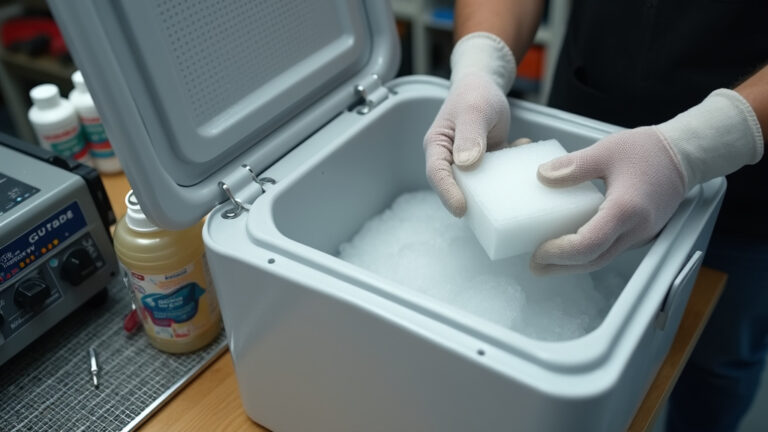
Dry ice fog is solid carbon dioxide sublimating in hot water. The “fog” is actually water vapor condensed by the cold CO2 gas. It stays low to the ground and contains no particles that smoke detectors are designed to sense. It’s arguably the safest effect for alarm avoidance, but it’s impractical for most events due to cost and handling requirements.
Common mistake: Assuming “low-lying” fog from a dry ice or chilled machine is safe for detectors near the ceiling. While the fog itself stays low, the chilled air and moisture can still rise and disperse, potentially reaching detectors in rooms with strong HVAC circulation.
7 Rules to Prevent a False Alarm (and a Fire Department Visit)
Theory is fine, but your gig is tonight. These are the rules I follow for every show, from a 50-person wedding to a 5,000-seat hall. Skip one, and you’re gambling.
1. Talk to the Fire Marshal Before You Load In.
This is non-negotiable. The phrase is “I’m the production manager for tonight’s event, and we’ll be using atmospheric effects. Can we schedule a 10-minute walk-through to identify detector locations and discuss a pre-show sensitivity test?” This frames you as a professional, not a problem. They hold the keys to the system, often literally. The professional fog machine usage guidelines from industry sources like PrimeSound align with this protocol.
2. Perform a Controlled Test with the System in “Monitor” Mode.
With the fire marshal present, have them put the relevant alarm zone into test or monitor mode. This silences the local horns and prevents an automatic dispatch. Run your machine at its lowest setting for 3 seconds. Watch the detector. Many modern systems have an LED that flashes faster when it detects particles. You’re finding the threshold.
3. Mind the 10-Foot Rule and Direction.
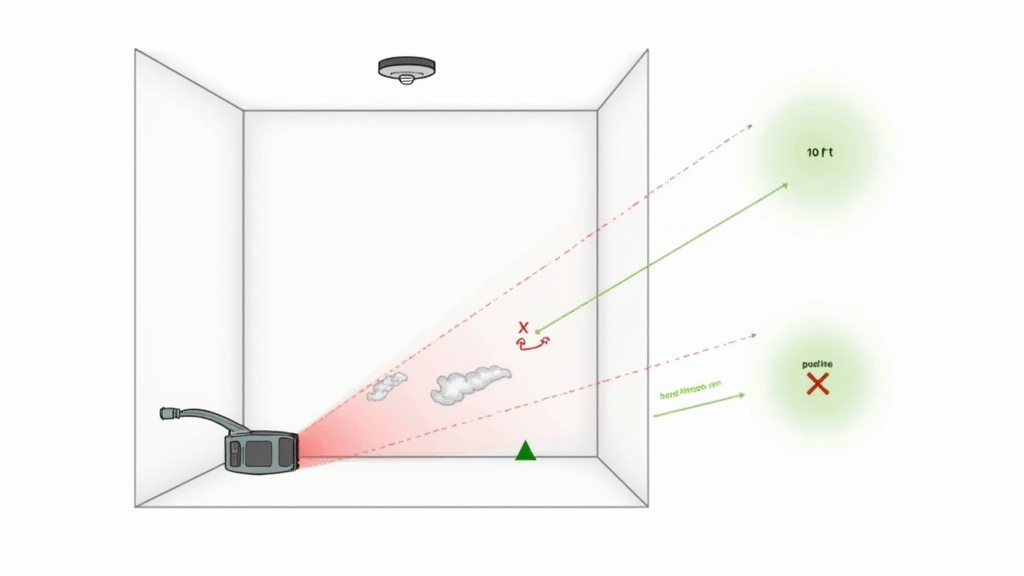
Placement is everything. Keep the output nozzle of the machine at least 10 feet from the nearest smoke detector. More distance is better. Crucially, aim the output parallel to the floor. If you point it up, you’re delivering a concentrated stream of trigger-particles directly to the detector. Let the fog spread naturally.
4. Use Short Bursts, Not a Constant Stream.
Your goal is atmosphere, not a cloud bank. Hit the remote for a 1-2 second burst, then wait for it to diffuse. This prevents a concentrated plume from traveling across the room and saturating the detector chamber. Continuous output is asking for trouble and often results in poor visibility anyway.
5. Leverage the Room’s Airflow.
Find the HVAC vents. If the system is on an exhaust setting, place your machine upwind of the detector so fog is pulled away from it. If it’s on recirculation, you’re fighting the system, the fog will cycle back. In that case, your burst timing and distance become even more critical. A box fan placed strategically can help direct fog away from sensitive areas.
6. Choose Your Fluid for Dispersal, Not Hang Time.
For high-risk rooms, use a fast-dissipating, water-based fluid. These are often labeled “haze” or “quick-dissipating” fog fluids. They create effects that vanish in 15-30 seconds, reducing the window for particle buildup. Avoid the heavy, glycol-rich fluids designed for extreme hang time. The flammability of fog is also a consideration with some fluid types.
7. Have a Designated Fire Watch if Alarms Are Disabled.
In some rare, pre-approved situations, a fire marshal may agree to temporarily disable a specific detector. If this happens, you must implement a “fire watch.” This is a sober, responsible person (not the DJ or the lighting operator) whose only job is to visually patrol the area and watch for actual fire. They must have a clear path to the manual pull station and know the evacuation plan. This is a last-resort, high-responsibility tactic.
What to Do When the Alarm Goes Off (Because It Might)
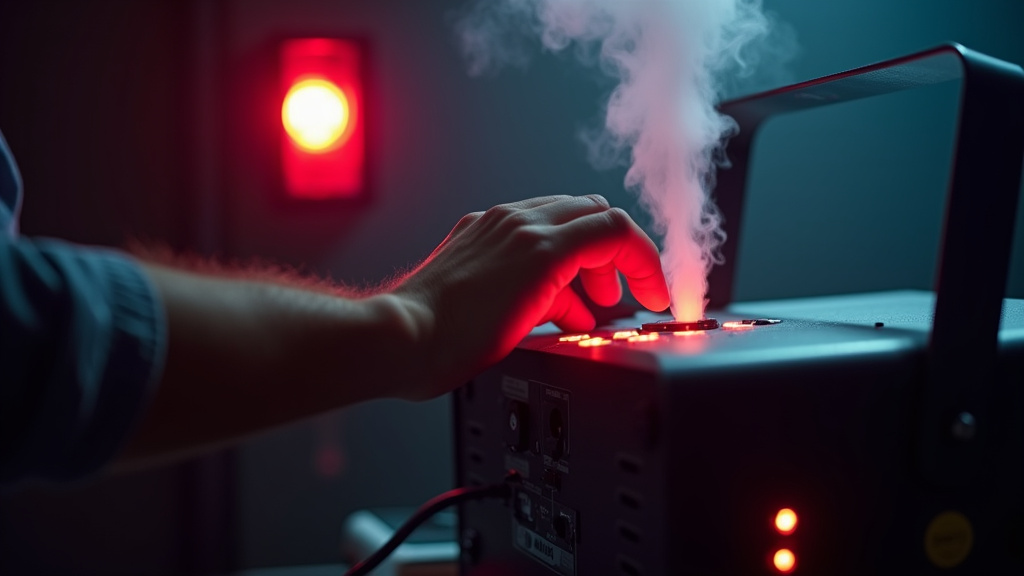
You followed the rules, but a stray draft sent a wisp into the detector. The horn blares. Now what? Panic makes it worse.
First, stop the fog machine immediately. Hit the power switch on the unit itself. Second, do not silence the alarm yourself unless explicitly instructed by the fire marshal. Tampering with fire safety equipment is illegal. Third, notify the venue’s designated safety officer or the front desk immediately. They have the protocol and likely a direct line to the monitoring station to call off the trucks if it was a false alarm.
The financial consequence is real. Many municipalities fine the venue for a false alarm, and that cost will be passed on to you, the client. The first offense might be $250. The third in a year can be over $1,000. This is why the pre-event conversation is worth its weight in gold.
Haze Machines: A Safer Path for Lighting Effects?
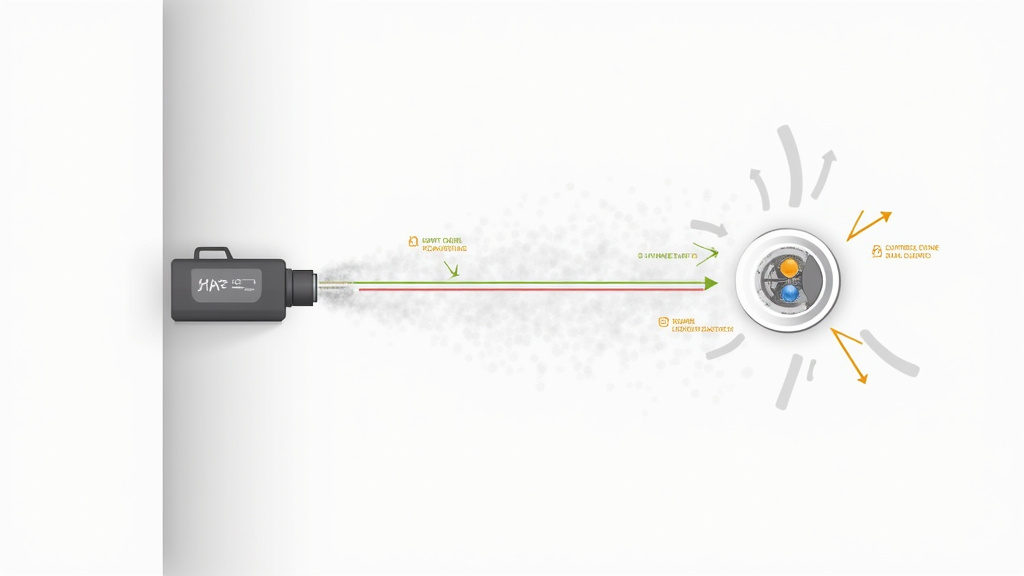
If your primary goal is to accentuate lasers and moving lights, a haze machine is often a smarter choice than a fog machine. The output is less dense and more uniform, creating that visible beam effect without the dramatic peaks in particle concentration that trigger alarms.
However, “less likely” is not “immune.” Haze will still set off a sensitive photoelectric detector if the room’s ventilation is poor and the haze accumulates. The testing rule still applies. Start with the haze output at its minimum setting and increase slowly during your supervised test until you see the detector’s indicator LED change pattern. That’s your maximum safe output level for that room.
Remember, factors like ambient humidity affect haze density. A dry room will let haze hang longer and potentially build up. A humid room may cause it to dissipate or condense faster. Your test gives you a baseline for the conditions that day.
Frequently Asked Questions
Can I just cover the smoke detector with a plastic bag?
Never. This is illegal, dangerous, and a surefire way to get banned from a venue. It also often triggers a “fault” signal on the fire panel, alerting staff. If the detector can’t sense smoke, it can’t save lives in a real fire.
Do low-lying fog machines avoid alarms?
They help, but don’t guarantee it. While the fog itself may stay low, the machine’s pump and the agitation of air can still send a mist of particles upward. Combined with room air currents from HVAC systems, these particles can reach ceiling detectors. Always test.
Are some fog fluids less likely to set off alarms?
Yes. Water-based fluids that produce a “dry,” quick-dissipating fog are better than oil-based or heavy glycol fluids. Look for fluids described as “low-residue” or “fast-dissipating.” The particle size and composition can vary slightly, affecting how quickly they scatter light in a detector.
What about voice-evacuation systems or VESDA?
Voice-evacuation systems are just speakers tied to a fire alarm control panel, the detectors are the same. VESDA (Very Early Smoke Detection Apparatus) is a whole different level. These are ultra-sensitive air-sampling systems used in data centers and museums. They will absolutely detect theatrical fog and are extremely difficult to work around. If you see pipes with small holes running across the ceiling, assume you cannot use fog without full system shutdown and a fire watch.
Will unplugging the smoke detector work?
Most commercial smoke detectors are hardwired with battery backups and report their status to a central fire panel. Unplugging it will cause a “trouble” or “supervisory” signal at the panel, alerting maintenance instantly. In residential settings, it’s still a terrible idea that compromises safety.
The Bottom Line
Fog machines and smoke alarms are destined to conflict because they’re both measuring the same thing: stuff in the air. Your escape from that conflict isn’t a trick, it’s procedure.
Know the detector type. Secure permission. Test with the system in a safe mode. Place the machine with intention. Control your output. This process turns a risky special effect into a repeatable, professional tool. The goal isn’t just to avoid a noisy interruption; it’s to prove you respect the venue’s safety systems as much as you value your show’s atmosphere. Get that right, and the only thing you’ll set off is the audience’s applause.