How to Control the Density of Fog: A Practical Event Guide
This post contains affiliate links. As an Amazon Associate, we earn from qualifying purchases.
To control the density of fog, adjust four factors: the machine’s output setting, the fog fluid’s chemical formula, the room’s airflow and distance, and the ambient temperature and humidity. Thick fog results from high output, high-viscosity fluid, still air, and cool, moist conditions.
To control the density of fog, you manipulate four things: the machine’s output setting, the chemical formula of the fog fluid, the distance and airflow in the room, and the ambient temperature and humidity. Thick fog comes from high output, high-viscosity fluid, minimal airflow, and cool, moist air. Thin, wispy haze is the opposite.
Most people crank the output to max, blast a room, and wonder why the fog looks patchy and vanishes in three minutes. They’re fighting the room’s climate with the wrong fluid.
This guide walks through each lever, machine, fluid, placement, and environment, with the specific settings and product choices that work for Halloween haunts, theater stages, and photo shoots. You’ll learn why glycerin matters, when to use a chiller, and how a twenty-dollar fan saves a two-hundred-dollar fluid bottle.
Key Takeaways
- Output is a dial, not a switch. Crank it to 100% and the heater can’t vaporize all the fluid, sending wet, drippy sputters into the room that condense on your floors.
- Fluid viscosity is everything. Thick, glycerin-heavy premium fog fluids create dense, lingering clouds. Thin, water-based formulas make a fast-evaporating mist.
- Cold air sinks, warm air rises. For ground-hugging fog, you need a fog chiller designs or a machine built for it; standard fog will always drift upward in a warm room.
- A fan is your density sculptor. An oscillating fan doesn’t just spread fog, it breaks up dense pockets and creates even, volumetric layers that look thick on camera but don’t choke the actors.
- Check humidity first. In a dry venue (under 40% relative humidity), even the best high-density fog liquids will vanish twice as fast. Plan to output more fluid or add a humidifier backstage.
The 4 Core Levers to Pull for Fog Density
Output control, fluid choice, machine placement, and room climate are non-negotiable. You can’t fix a bad fluid with a bigger machine. You can’t overcome a hot, dry room with any setting.
The first step is always the output knob or remote. Modern machines have variable controls, not just an on/off switch.
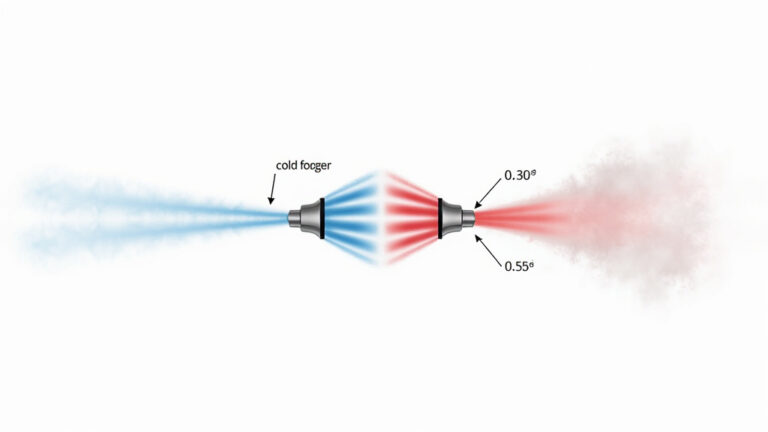
Fog density correlates directly with the mass of fluid vaporized per second. A machine set to 30% output produces a mist with a droplet concentration roughly one-third that of its 100% setting, assuming all other factors, fluid type, ambient temperature, remain constant.
Set it to 50% as a baseline. Watch the plume. If it’s too wispy, nudge it up in 10% increments. If it’s too thick and wet, turn it down. The heater core needs time to fully vaporize the fluid; exceeding its thermal capacity gives you sputtering, not fog.
TL;DR: Start at 50% output. Adjust in 10% increments based on visibility. Max output often causes sputtering, not thicker fog.
Fog Fluid Chemistry: It’s Not Just “Juice”
The fluid in your bottle is a cocktail. The base is usually deionized water or a glycol. The active ingredient is typically glycerin or a similar polyol. The ratio of water to glycerin defines the fog’s personality.
High glycerin content means higher viscosity. This thicker fluid vaporizes into larger droplets that hang in the air longer. This is your dense fog formulas for haunted houses. Low glycerin content means the fluid is mostly water. It vaporizes into a fine mist that evaporates quickly, perfect for a subtle theatrical fog liquids haze that won’t set off smoke alarms.
| Fluid Type | Primary Use | Typical Density | Persistence in Still Air |
|---|---|---|---|
| Water-Based, Low-Glycol | Concert haze, photo shoots | Low, wispy | 2–5 minutes |
| Glycol-Based, Balanced | General theatrical fog | Medium | 5–10 minutes |
| Glycerin-Heavy, High-Viscosity | Horror effects, dense atmosphere | High, opaque | 10–20+ minutes |
| Specialized Low-Lying Fluid | Chilled ground fog | Very High, ground-hugging | 3–8 minutes (with chiller) |
Common mistake: Using a water-based fluid in a large, cold warehouse, the fog evaporates before it crosses the stage, leaving the director wondering why the machine “isn’t working.” You needed a glycol-based formula.
I learned this the hard way on a Halloween gig. We used a cheap, watery DIY fog fluid in a cold, damp cemetery set. The fog vanished as soon as it left the nozzle. Switched to a professional glycerin-based fluid mid-show. The difference wasn’t subtle. The graves stayed shrouded for the entire three-hour event.
TL;DR: Glycerin content equals hang time. For dense fog, buy fluids labeled “thick,” “high-density,” or “long-lasting.” For haze, buy “low-lying” or “fast-dissipating.”
Machine Placement and Airflow Are Your Secret Weapons

Distance matters. A machine placed twenty feet from the action will produce a diffuse cloud by the time it arrives. Place it five feet away, and the fog hits dense and concentrated.
But you can’t always hide a machine in the middle of the stage. This is where airflow takes over.
A simple box fan is the most underrated tool in fog control. Point it directly at the fog output as the plume emerges. This shears the dense core into a wider, more even distribution that looks thick from the audience but doesn’t create a blinding wall.
For shaping, use an oscillating fan on a slow sweep. It pushes the fog into drifting layers, creating that cinematic, volumetric look. Without a fan, fog follows physics, it pools in low spots and rises with thermal currents. You get uneven pockets.
TL;DR: Hide the machine close. Use a fan to spread and shape the output. Still air creates pools; moving air creates even layers.
Why Your Room’s Climate Is the Final Boss
Fog is water vapor condensing into tiny droplets. What the air is already doing with water decides everything. The National Weather Service fog guide explains the natural principle: fog forms when air cools to its dew point, reaching 100% relative humidity.
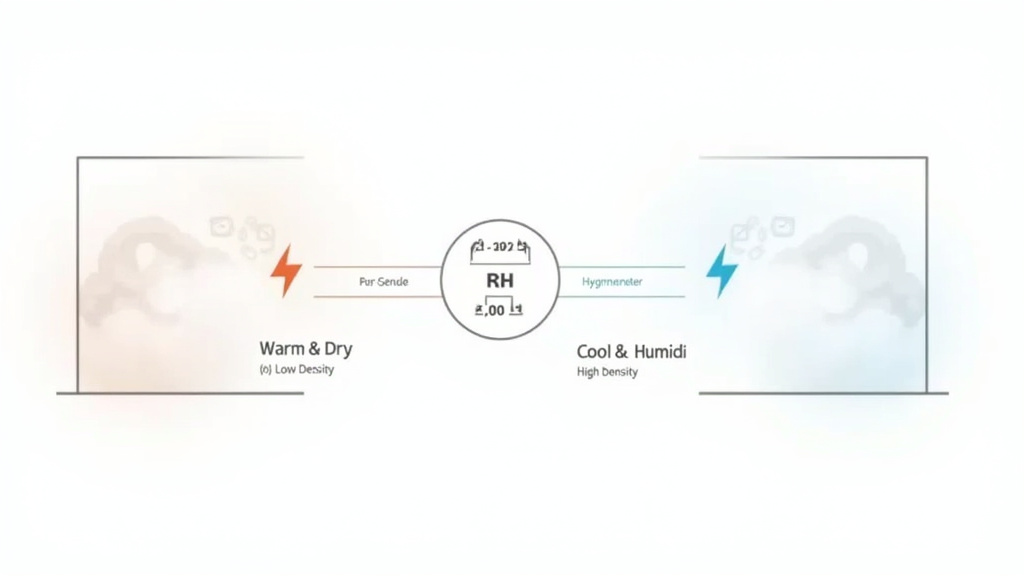
Your machine artificially creates that condition by injecting vapor. If the room air is warm and dry (low relative humidity), it’s a sponge. It eagerly absorbs your fog, causing rapid evaporation and a thin effect. If the room is cool and damp (high relative humidity), the air is nearly saturated. Your added vapor has nowhere to go, so it condenses into a dense, persistent cloud.
This is why fog behaves perfectly in a damp basement and disappears in a climate-controlled conference hall.
Before you start: Uncontrolled fog can obscure exit signs, trigger sensitive smoke alarms, and create slippery residues on floors. Always test in an empty venue first, ensure ventilation paths are clear, and have a plan to quickly dissipate fog if needed.
The Temperature-Humidity Balancing Act
You need a digital hygrometer. They cost fifteen dollars. Knowing your room’s relative humidity (RH) before you plug in the machine is non-negotiable.
- High RH (Above 60%), Cool Temp (Below 70°F): This is ideal for dense fog. You can use less fluid for density because the environment helps you. The fog will linger.
- Low RH (Below 40%), Warm Temp (Above 75°F): This is the worst-case scenario. You will burn through optimal fog fluid trying to achieve density. Your only real levers are cranking output, using the thickest fluid you have, and physically cooling the air or the fog itself with a chiller.
I won’t try to hit a dense, stage-filling effect in a dry, heated ballroom without a fog chiller. The physics are against you, and you’ll empty three bottles of fluid for 20 minutes of mediocre fog. Sometimes the right answer is to change the creative expectation.
TL;DR: Cool, humid air = dense, long-lasting fog. Warm, dry air = thin, vanishing fog. Measure your room’s RH with a hygrometer.
Advanced Techniques for Precision Control

Beyond the basics, specific tools and methods give you surgical control. These are for when “pretty good” fog isn’t enough.
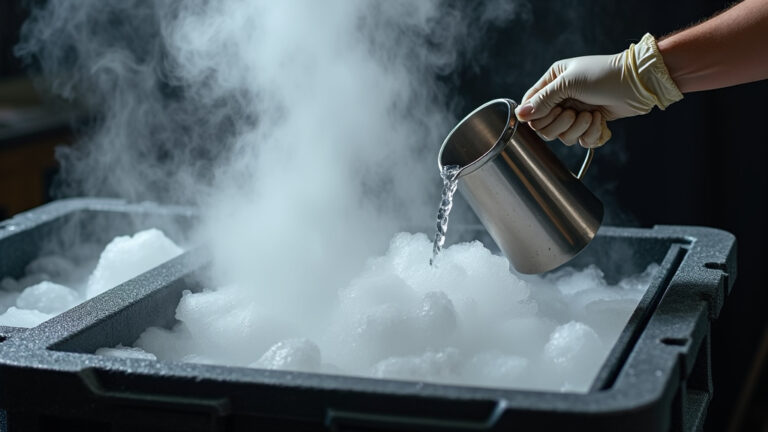
Fog Chillers for Low-Lying Effects: Standard fog is warm when it exits the machine, so it rises. A fog chiller, a insulated box or coil filled with ice, cools the fog before it hits the air. The cold, dense fog then rolls along the ground. This requires formulas for low fog designed to work with chilling; standard fluid can gum up.
Haze Machines for Uniform Density: A haze machine is different. It produces an ultra-fine, dry particulate that hangs almost motionless in the air for hours. It doesn’t look like “fog” but creates stunning volumetric light beams. For consistent, all-encompassing density that won’t dissipate, haze is the professional choice.
Chemical Additives (With Caution): Some advanced users add small amounts of propylene glycol or food-grade glycerin to their fluid to increase viscosity and droplet size. This is detailed in research like the Springer Nature aerosol science article on optimizing fog properties. This is a advanced technique. Too much additive can clog your machine’s pump and heater. I don’t recommend it unless you’re willing to deep-clean your machine afterwards.
| Technique | Best For | Key Requirement | Risk If Done Wrong |
|---|---|---|---|
| Fog Chiller | Ground-hugging horror effects | Ice or refrigeration unit, low-lying fog juice | Wet, slushy fog that stains floors if fluid isn’t compatible |
| Haze Machine | Concert lighting, long-duration film shoots | Dedicated haze fluid, good ventilation | Can set off particle-based smoke alarms; leaves a fine dusting on surfaces over days |
| Fluid Additive Tuning | Laboratory or precise industrial replication | Precision scales, pure chemicals, machine disassembly knowledge | Permanent clogging of the machine’s internal tubing and nozzle |
TL;DR: For ground fog, use a chiller. For all-day density, use a haze machine. Modifying fluid chemistry is for experts only.
Troubleshooting: Fog Too Thin, Too Dense, or Gone Too Fast
Here is your field guide for when things don’t look right.
Problem: Fog is thin and disappears in under a minute.
- Check 1: Room humidity. Is it below 40%? If yes, you are fighting physics. Increase output and switch to a high-density fog liquids.
- Check 2: Fluid type. Are you using a “haze” or “fast-dissipating” fluid? Switch to a “thick” or “dense” formula.
- Check 3: Machine output. Is it set below 50%? Bump it up.
Problem: Fog is too dense, creating a blinding wall or wet residue.
- Check 1: Output is too high. Turn it down. The heater might be overwhelmed.
- Check 2: Fluid is too viscous. You might be using a dense fog formulas meant for outdoor use in a small room. Dilute with 10% distilled water (check machine manual first) or switch fluid.
- Check 3: No airflow. Add a fan to disperse the cloud.
Problem: Fog rises immediately instead of staying low.
- Check 1: The fog is warm. You need a fog chiller designs to cool it.
- Check 2: You are not using a fluid formulated for low-lying effects. Standard fluid will always rise.
Frequently Asked Questions
What’s the difference between fog fluid and haze fluid?
Fog fluid is designed to create a visible cloud with larger droplets. Haze fluid is a finer formula that creates an almost invisible particulate suspension meant to hang in the air for hours, making light beams visible. They are not interchangeable in most machines.
Can I use a regular fog machine to make low-lying fog?
Not effectively. The fog is warm as it exits, so it will rise. You can direct it along a cold floor for a second or two, but for a true rolling ground effect, you need a fog chiller to cool the output or a dedicated low-lying fogger that uses a refrigeration unit.
How do I stop fog from setting off smoke alarms?
Use a haze machine, as its particulate is less likely to trigger ionization alarms. For fog machines, use a fast-dissipating fluid, ensure strong ventilation away from the detector, and communicate with the venue about temporarily shielding or disabling alarms during the effect (always with a fire safety professional present).
Is thicker fog fluid bad for my machine?
It can be. High-viscosity, glycerin-heavy fluids put more strain on the pump and can leave more residue on the heater if the machine isn’t powerful enough to fully vaporize it. Always use a fluid that matches your machine’s specifications. Using a professional-grade fluids designed for your machine model is the safest bet.
Why does my fog smell sweet or weird?
Most fog fluids use glycols or glycerin as the base, which have a faintly sweet odor when vaporized. Low-quality or old fluid can develop a burnt, acrid smell. A strong chemical smell can indicate the wrong fluid type or a machine overheating. Always use fresh, reputable fog liquid brands.
Before You Go
Controlling fog density isn’t a mystery. It’s a system. Start with the machine’s output dial, but understand that’s just the first step. Your choice of fluid viscosity control, the glycerin content, determines the fog’s staying power and opacity. Your room’s hidden climate, its temperature and humidity, is the silent partner that can make or break your effect.
For that iconic, creeping ground fog, the answer is always a chiller and a compatible low-lying effect juices. For a uniform, all-enveloping density that lasts for a concert, a haze machine is the professional tool. Keep a fan nearby to shape and save your effect from pooling. Now you know what each lever does. Go turn them.