How Much Electricity a Fog Machine Uses: Wattage & Cost Guide
This post contains affiliate links. As an Amazon Associate, we earn from qualifying purchases.
To calculate how much electricity a fog machine uses, find its wattage rating (typically 400-3000W), multiply by your hours of use, and divide by 1000 to get kilowatt-hours (kWh). Multiply kWh by your local electricity rate for the cost. A 1000W machine run for 3 hours uses 3 kWh, costing about $0.45 at the U.S. average rate.
Most people look at the fog output rating and ignore the power rating. They plug in a 1500-watt machine, run it for a Halloween night, and get a nasty surprise on their next electricity bill. The wattage number tells the real story of heat, density, and cost.
This guide breaks down fog machine wattage from small party units to professional rigs. You’ll learn how to calculate your exact electricity cost, understand why these machines are power-hungry, and get practical advice for powering them safely at home or for an event.
Key Takeaways
- Wattage dictates fog density and operating cost. A 500W machine makes a light mist for a room; a 2000W machine produces a thick, rolling cloud for a stage.
- Always add a 20% buffer to your power source’s capacity. A 1000W fog machine needs a 1200W-rated inverter or generator to handle the initial heating surge.
- The heating element is the power hog. It must reach 200–300°C (392–572°F) almost instantly to vaporize the fluid, which is why even small units draw 400+ watts.
- Intermittent use is key to managing cost. A pro machine might draw 2000W, but it only cycles on for 30 seconds every few minutes, so your total kWh stays manageable.
- Haze machines use less power continuously. They create a suspended atmospheric mist with a lower-wattage pump and heating system, often under 300W.
Fog Machine Wattage Range: Small to Professional
Head design changes the entire process. Look at the business end of your trimmer.
Fog machine wattage splits into three clear tiers: entry-level, mid-range, and professional. The wattage number, usually found on a label near the power cord, is your primary indicator of capability and electrical demand. A higher rating doesn’t just mean more fog, it means denser fog, faster recovery between bursts, and a heavier draw on your circuit.
Entry-level machines (400–700W) are built for living rooms and small parties. Mid-range models (500–1000W) handle larger indoor spaces or backyards. Professional foggers (1000–3000W) are for stages, haunt attractions, and large venues where dense, sustained output is non-negotiable.
TL;DR: Match wattage to your space. Under 700W for a room, 1000W for a house, 1500W+ for anything larger.
The 400–700 Watt Tier: Home and Party Use
Machines in this range are common Halloween picks and budget-friendly units. They often have plastic housings and simpler internal pumps. Their heating elements are smaller and take longer to reach operating temperature, anywhere from three to five minutes is standard. The fog they produce is adequate for creating atmosphere in a 20×20 foot room or a garage haunted house.
The power draw is manageable for a standard 15-amp household circuit, which can handle about 1800 watts. You can typically run one of these plus some LED lights on the same circuit without tripping a breaker. Their lower wattage makes them a candidate for portable power stations, but you still need to check the station’s surge rating.
Common mistake: Assuming a 500W machine can fill a large backyard, it will produce a thin, wispy cloud that dissipates quickly in open air, forcing you to run it continuously and burning through fluid.
The 500–1000 Watt Tier: The Reliable Workhorse
This is the sweet spot for serious home users, school theaters, and small DJs. Machines here, like many recommended models, often feature metal construction, more robust fluid pumps, and faster warm-up times. The increased wattage translates directly to a hotter heating element.
A hotter element vaporizes fluid more completely. This creates a denser fog that hangs in the air longer and appears whiter or more opaque. You get more visual impact per second of fog output. The trade-off is a more significant power draw. Running a 1000W machine for an hour straight uses as much electricity as a medium-sized window air conditioner.
The 1000–3000 Watt Tier: Professional-Grade Power
These are the machines you see at concerts, in professional haunted houses, and on film sets. Brands like Antari, MDG, and High End Systems dominate here. Wattage above 1500 is about two things: immense fog density and rapid recovery.
A 2500W heating element can bring a large thermal block up to 300°C in under 90 seconds. It can then sustain near-continuous output because it reheats the block almost instantly after each burst. This is why they’re called “fog generators” rather than just fog machines. The power requirement is serious. A single 2000W machine draws nearly the full capacity of a 15-amp circuit, leaving no room for anything else on that line.
| Machine Tier | Typical Wattage | Best For | Circuit Consideration |
|---|---|---|---|
| Entry-Level / Party | 400–700W | Small rooms, home Halloween | Safe on any 15A circuit with other low-wattage devices. |
| Mid-Range / Prosumer | 500–1000W | Large rooms, school stages, backyard events | Can dominate a circuit; avoid sharing with amps or heavy lighting. |
| Professional / Commercial | 1000–3000W | Theaters, concerts, large-scale haunts | Often requires a dedicated 20A circuit or higher; consult a venue electrician. |
Why Fog Machines Are Power Hungry (The Heating Element)
The answer is simple physics. Fog fluid is primarily water and glycol. To turn it into a visible aerosol, you must flash-boil it. The machine’s pump pushes a precise amount of fluid onto a metal heating block, often made of aluminum or brass. This block must be hot enough to vaporize the fluid on contact, not just warm it.
That threshold is between 200°C and 300°C (392°F to 572°F). Reaching and maintaining that temperature in a metal mass requires a lot of energy, delivered fast. The heating element is a coiled resistance wire, similar to an electric stove burner but smaller. When you turn the machine on, the element draws its full rated wattage continuously until the thermostat signals the block is at temperature.
This initial surge is the highest power draw. Once at temperature, the element cycles on and off to maintain heat, but each new burst of fog cools the block slightly, triggering another powerful surge to reheat it. This on-off cycling is why your total energy use depends on how frequently you fire the machine. A single long blast uses less total energy than ten short blasts over the same period.
Haze machines work differently. They use a lower-temperature heating element (or sometimes just a pump and a compression nozzle) to create a fine, dry mist. The haze particle is much smaller and doesn’t require the same violent phase change. Consequently, a typical haze machine might draw only 200–400 watts continuously, compared to a fog machine’s 1000+ watt bursts.
Calculating Your Fog Machine’s Electricity Cost
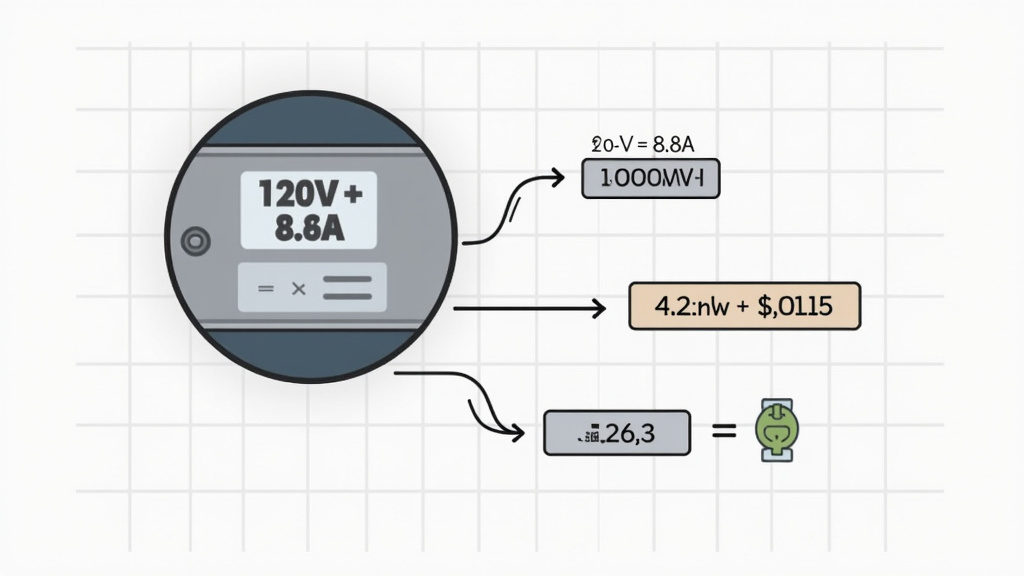
You need three numbers: your machine’s wattage, your total runtime, and your local cost per kilowatt-hour (kWh). The formula is straightforward, but people trip on estimating runtime. You must count the total time the machine is plugged in and powered on, including its warm-up period, not just the seconds it’s emitting fog.
Step 1: Find the wattage. Look on the machine’s back or bottom plate. It will say something like “120V ~ 60Hz 8.3A”. Multiply volts by amps to get watts: 120V * 8.3A = ~1000W. If it just says “1000W”, use that.
Step 2: Estimate runtime in hours. Planning a 4-hour Halloween party? Your machine will be on for at least that long, plus its 5–10 minute warm-up. Call it 4.2 hours.
Step 3: Calculate kilowatt-hours (kWh). Multiply wattage by hours, then divide by 1000.
(1000 watts * 4.2 hours) / 1000 = 4.2 kWh
Step 4: Find your electricity rate. Check your utility bill. The U.S. national average was about $0.15 per kWh in early 2025. Your rate could be as high as $0.30 in some areas.
Step 5: Calculate the cost. Multiply kWh by your rate.
4.2 kWh * $0.15 = $0.63
Running a 1000W machine for a 4-hour party costs around 63 cents. That seems trivial. But scale changes everything.
Let’s run a scenario for a weekend-long haunted attraction using a professional 2000W machine.
- Wattage: 2000W
- Runtime: 6 hours per night, for 3 nights, plus 0.5 hours of warm-up each night = 19.5 total hours.
- kWh: (2000 * 19.5) / 1000 = 39 kWh
- Cost at $0.15/kWh: 39 * 0.15 = $5.85
The electricity cost for the fog machine alone is under six dollars. The real cost driver for a business is fluid consumption, not power. However, if you’re using multiple machines or your local rate is $0.30/kWh, that cost can quickly jump to $20 or $30 for the weekend. It adds up.
Common mistake: Forgetting the warm-up cycle in your calculations, a 10-minute warm-up for a 1500W machine uses 0.25 kWh before it even produces a puff of fog.
Powering Your Fog Machine: Outlets, Inverters, and Generators
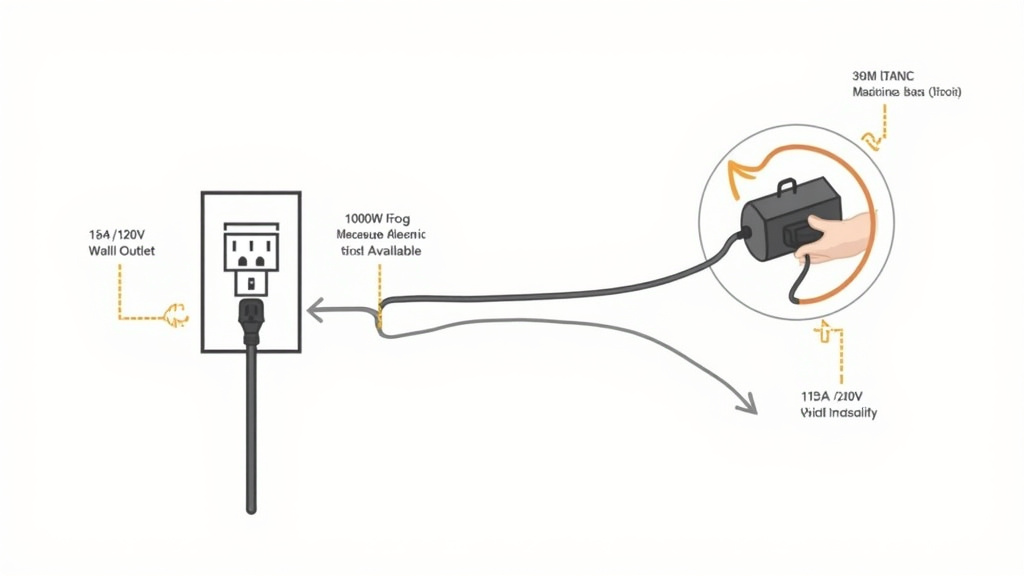
You cannot just plug a high-wattage fogger into any outlet. You must understand the capacity of your power source, both for safety and performance. The Electrical Safety Foundation International (ESFI) emphasizes not overloading circuits, which is a primary risk with high-wattage devices like fog machines.
Household Outlets (USA/Canada): A standard 15-amp, 120-volt outlet can safely deliver about 1800 watts continuously (80% of its 15A*120V=1800W rating). A 1000W fog machine leaves 800W for other devices on that circuit. Be aware that multiple outlets in a room are often on the same circuit. If your fog machine, a 500W LED par light, and a 300W audio amp are all on the same circuit, you’re at 1800W and risk tripping the breaker.
Power Inverters and Batteries: This is critical for outdoor or mobile use. The wattage rating on your inverter is its continuous output. Fog machines have a high surge demand when the heating element first kicks on. You need an inverter rated for at least 20% more than your machine’s wattage.
* For a 700W machine, get a 1000W (or better, 1200W) inverter.
* For a 1000W machine, you need a 1500W inverter.
The battery must support that draw. A 100Ah 12V deep-cycle battery holds about 1200 watt-hours (100Ah * 12V). Running a 1000W machine would drain it in just over an hour, not counting inverter efficiency losses.
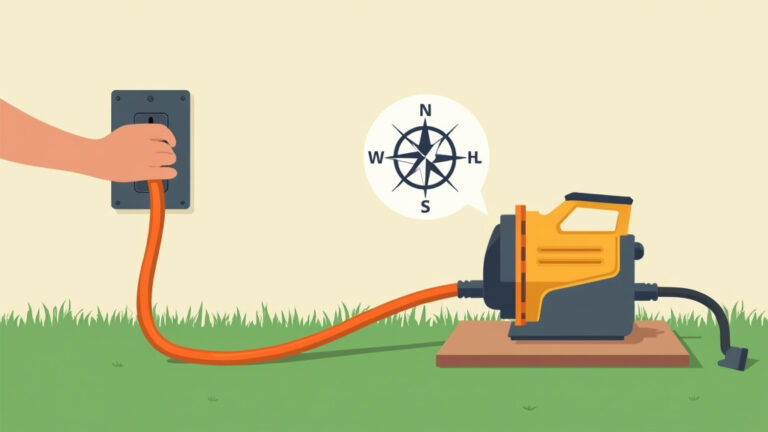
Generators: The same 20% buffer rule applies. A generator’s rated wattage is its continuous output. A “2000 watt” generator can typically handle a 1600W continuous load. For a 1500W fog machine, this is fine. But if you also need to power lights and sound, you’ll need a larger unit. Always place the generator downwind and away from the performance area to avoid fumes and noise interference.
Before you start: Never use an extension cord rated for less amperage than your machine draws. A light-duty cord will overheat, melt, and pose a fire risk within minutes under a 10-amp load. Use a 14-gauge or heavier cord for any run over 25 feet.
Factors That Increase Electricity Use
Several variables can push your actual consumption higher than the basic math suggests. The first is ambient temperature. Using a fog machine in a cold garage or outdoors on a chilly night forces the heating element to work harder and cycle more often to maintain its setpoint. Your 1000W machine might behave like a 1200W machine under those conditions.
Output setting is another major factor. Many machines have a variable output control. Cranked to maximum, the pump injects fluid at a higher rate. The heating element must supply more energy to vaporize that increased volume, drawing more power for longer periods during each fog burst. Running at max output continuously is the most energy-intensive mode.
Fluid type and quality also play a role. Thicker, premium fluids designed for high-density output may require slightly higher temperatures for complete vaporization. Cheap, watery fluids might vaporize easier but produce a thinner, less impressive fog, meaning you’ll run the machine more often to achieve the desired effect, netting the same or higher total energy use.
Finally, don’t forget the “extras.” Modern fog machine types often include built-in LED lights, DMX controllers, or even audio effects. While these add-ons draw relatively little power individually (5-20W for LEDs), they add to the total load on your power source. It’s cumulative.
Fog vs. Haze Machines: A Power Comparison
This distinction explains why a venue might choose one over the other, beyond the visual effect. The core difference is in the mechanism and the intended result.
A fog machine creates a dense, opaque cloud by flash-vaporizing fluid. It’s a high-power, intermittent device. Think of it like a kettle boiling violently for short bursts. A 1500W fog machine might cycle on for 30 seconds, then off for two minutes while the fluid reservoir repressurizes and the block stabilizes.
A haze machine creates a nearly invisible, suspended mist that makes light beams visible. It uses a pump to force fluid through a very fine nozzle, sometimes with gentle heating to reduce particle size further. It’s a low-power, continuous device. A 250W haze machine might run quietly for an entire four-hour concert, maintaining a consistent atmosphere.
| Aspect | Fog Machine | Haze Machine |
|---|---|---|
| Primary Power Draw | Heating element (2000–3000W in bursts) | Pump + low-watt heater (200–500W continuous) |
| Output Character | Dense, opaque, dramatic clouds | Thin, atmospheric, suspended mist |
| Typical Use Pattern | Short, powerful bursts every few minutes | Continuous, low-level output |
| Energy Use Over 4 Hours | High peak, but lower total kWh if used sparingly | Lower peak, but can equal or exceed fog’s total kWh due to continuous run |
TL;DR: Fog for dramatic reveals and high-impact moments; haze for sustaining atmosphere under lighting. Haze is often gentler on a venue’s electrical system despite running longer.
Reducing Your Fog Machine’s Energy Footprint
You can manage consumption without sacrificing effect. The first rule is to use the machine intermittently. Program it for short, timed bursts rather than letting it run on a manual trigger where you might hold the button down too long. Many pro and prosumer models have timer functions for this reason.
Match the machine to the space. Using a 2000W machine to fog a 10×10 bedroom is massive overkill. You’ll achieve the same visual effect with a 500W indoor model using a fraction of the power. Conversely, trying to fill a warehouse with a small machine forces it to run non-stop, overheating the unit and maximizing your electricity cost for a poor result.
Maintain your machine. A clean heating element and fluid path operate more efficiently. Scale and carbonized fluid residue (caused by using cheap fluid or running the machine dry) act as insulators on the heating block. The element must work harder and longer to reach temperature, wasting electricity. Descaling and cleaning according to the manual preserves efficiency.
Consider the environmental impact of your overall setup. While a single machine’s power use is modest, large events with multiple machines, lighting, and sound have a combined load. Using LED lighting instead of incandescent can free up significant circuit capacity and reduce the total venue power demand, making it easier and safer to run your foggers.
Frequently Asked Questions
Does a fog machine use a lot of electricity?
It depends on the machine’s wattage and how you use it. A small 400W unit used for a few minutes at a party uses very little electricity, perhaps a few cents worth. A professional 2000W machine running frequently over a multi-day event can add several dollars to your bill. The potential for high use is there, but typical home use is not a major cost driver.
Can I run a fog machine on a battery?
Yes, but you need the right equipment. You must use a power inverter rated well above the fog machine’s wattage (add 20-30% buffer) and a sufficiently large deep-cycle battery. A 1000W fog machine would require at least a 1500W inverter and a 100Ah battery for about an hour of runtime, excluding warm-up.
How many watts is a good fog machine?
For most home and party uses, a 500–1000 watt machine is the best balance of power and practicality. It provides enough output for dramatic effect without overwhelming standard household circuits. This range covers many of the top fog machines recommended for versatility.
Why does my fog machine keep tripping the breaker?
Your machine’s wattage, combined with other devices on the same circuit, exceeds the circuit’s 15- or 20-amp limit. Unplug other high-draw devices (amps, space heaters, coffee makers) from outlets on the same circuit. If the problem persists, the machine’s heating element may be failing and drawing excessive current, or you may need to plug it into a dedicated circuit.
Does a fog machine need to stay on to work?
Yes, during use. The machine must remain powered on to keep its heating block at operating temperature. However, between uses, you can turn it off. Just remember you’ll face the full warm-up time again when you power it back on, which uses electricity without producing fog.
Are newer fog machines more energy efficient?
Marginally. Improvements focus on better insulation for the heating chamber and more precise thermostatic control, which reduces cycling. However, the fundamental physics of flash-vaporizing fluid hasn’t changed, so a 1000W machine from today still uses roughly the same power as one from ten years ago to produce the same amount of fog.
The Bottom Line
Your fog machine’s wattage is the single most important number for predicting its electricity use. Find it, respect it, and plan your power source around it with a healthy buffer. For home users, the cost is negligible, a few dimes for a night of atmosphere. For event pros, the cost is a small but real line item, easily calculated and managed.
The real expense isn’t the electricity; it’s the fluid. And a machine that’s underpowered for your space will burn through fluid and electricity trying to catch up, giving you the worst of both worlds. Choose a machine with appropriate wattage, use it in deliberate bursts, and ensure it has clean, dedicated power. The result is dense, impressive fog without tripped breakers or bill shock. That’s how you elevate a gathering from ordinary to unforgettable.