Fog Machine Warm-Up Times: How Long & What to Know

This post contains affiliate links. As an Amazon Associate, we earn from qualifying purchases.

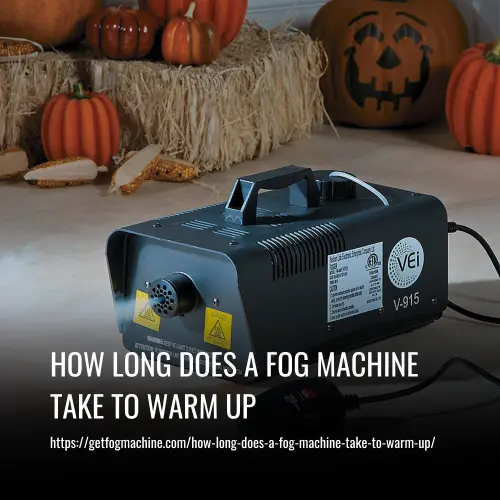
Fog machine warm-up times are typically 3 to 10 minutes. The exact duration depends on wattage, ambient temperature, and whether it’s a first use. The only reliable signal the heating element is ready is a green indicator light on the machine or its remote control.

Most fog machines need a warm-up period of 3 to 10 minutes before they can produce fog. The exact time depends on the machine’s wattage, the ambient temperature, and whether it’s the first use. A green “ready” light on the machine or its remote is the only reliable signal that the heating element has reached the correct temperature.

People ruin fog machines by pressing the trigger before that light turns green. The pump forces cold fluid into a hot heat exchanger, and the sudden thermal shock cracks the ceramic heating block. You’ll smell burning plastic before you see smoke, and the machine won’t output fog again without a full rebuild.

This guide covers the warm-up times for different machine types, the physical reasons behind the wait, and the mistakes that burn out a heating element in two seconds.

Key Takeaways

  • A standard 1000W fog machine takes 6–8 minutes to warm up. High-power fog jets (1500W+) can be ready in 4–7 minutes. Small 400W party machines often need 5 minutes.
  • The ready light is mandatory. Never trigger fog output before it illuminates. Doing so forces cold fluid into a hot heat exchanger and cracks the ceramic block.
  • Ambient temperature changes the wait. A machine in a 10°C warehouse takes two minutes longer to reach temperature than the same unit in a 25°C room.
  • Oil-based haze machines don’t preheat. They atomize fluid without a heating cycle, so they’re ready instantly. Glycol-based fog machines always need warm-up.
  • After use, let the machine cool down for 45 minutes before moving or storing it. The heat exchanger stays dangerously hot, and the residual fluid inside can boil if shaken.

How Long Does a Fog Machine Take to Warm Up?

Warm-up time is dictated by wattage. A 400W consumer-grade machine heats its small block in about five minutes. A 1000W standard fog machine, the kind used for stage shows and Halloween events, needs six to eight minutes. High-impact fog jets, like the 2000W units for concert venues, can reach temperature in four to seven minutes because their larger heating elements are more efficient.

The Rosco Vapour fog machine user guide specifies a 7-minute warm-up period for its 1200W model. This is a manufacturer-stated benchmark for a professional-grade unit. Cheaper machines with less precise temperature control often list a range like “5–10 minutes” because their heating cycles are less consistent.

You measure readiness by the light, not the clock. The machine has a thermostat monitoring the heat exchanger. When the fluid path reaches the optimal temperature for vaporization, usually between 150°C and 200°C, the thermostat signals the control board, and the ready light turns green. If you trigger before that, you’re guessing.

TL;DR: Wattage decides the wait: 400W takes ~5 minutes, 1000W takes 6–8 minutes, 2000W+ takes 4–7 minutes. The green ready light is the only valid “done” signal.

The Ready Light Rule (And What Happens If You Break It)

The ready light isn’t a convenience. It’s a safety interlock. Inside the machine, a ceramic or metal heating block wraps around a coiled tube called the heat exchanger. Fog fluid sits in a reservoir, and a pump sends it through that tube when you press the trigger. If the tube isn’t hot enough, the fluid doesn’t vaporize. It just sits there, wet and cold.

Now press the trigger early. Cold fluid hits a hot ceramic block. The thermal shock differential can exceed 100°C in a second. Ceramic cracks. Metal blocks warp. The next time the machine heats, the cracked block doesn’t transfer heat evenly, and the fog output turns weak and sputtering. Within three uses, the pump starts struggling because the fluid isn’t vaporizing properly, and the motor clogs with half-vaporized glycol sludge.

Common mistake: Triggering fog before the ready light, the cold fluid thermal-shocks the heating block, causing cracks that kill output within three uses. You’ll hear the pump laboring and see sputtering fog instead of a steady stream.

That’s the physical reason you wait. The block needs to reach a stable, even temperature across its entire surface. A thermostat measures that at one point; the light tells you the point is ready, but the whole block needs those extra minutes to equalize. Rushing it creates hot spots and cold spots, and the fluid vaporizes unevenly. Your fog looks thin and dies quickly.

First Use vs. Subsequent Warm-Ups

A brand-new machine takes longer on its very first heating cycle. The internal components are at room temperature, and the heat exchanger has no residual warmth. That initial warm-up might stretch to the maximum of the advertised range, say, 10 minutes for a machine that normally takes 7.

After that first use, subsequent warm-ups are faster if the machine hasn’t fully cooled. If you used it an hour ago, the block might still be at 50°C. The thermostat sees that and cuts the heating cycle short. The ready light could appear in five minutes instead of seven. This is why professionals at a multi-act concert leave machines powered on between sets; they maintain a baseline temperature and the warm-up for the next cue is almost instant.

But don’t confuse this with a machine that’s been off for a day. Once the block cools to ambient temperature, the warm-up time reverts to the standard duration. There’s no magic memory.

What Affects Fog Machine Warm-Up Time?

Four factors change how long you wait: ambient temperature, power source stability, fluid type, and machine condition.

Factor Effect on Warm-Up Time Why It Matters
Low ambient temperature Increases time by 1–3 minutes The heating block starts colder, requiring more energy to reach target temperature.
Unstable/low-power outlet Increases time unpredictably; may prevent readiness The heating element draws less current, heating slower or unevenly.
Wrong fluid viscosity Can increase time or cause no fog Thick fluid doesn’t flow smoothly into the heat exchanger, delaying vaporization.
Clogged or dirty nozzle Doesn’t affect warm-up, but affects output The machine heats fully, but fog can’t exit, causing back-pressure and pump strain.

Ambient temperature is the silent variable. A fog machine stored in a cold garage in winter starts its heating cycle with the block at maybe 5°C. The same machine in a warm studio starts at 22°C. The difference in energy needed to reach 150°C adds minutes. You’ll see the ready light delay accordingly. If you’re setting up outdoors in fall, plan for the extra wait.

Power source quality matters more than people think. A fog machine’s heating element is a constant draw, say, 1000W at 120V. If you plug it into a long extension cord or a shared outlet with other high-draw devices, the voltage at the machine’s terminals can drop to 110V. The element still tries to heat, but with less power. It takes longer, and the temperature might not reach the full set point. The ready light might never turn green, or it might flicker. Use a dedicated outlet, and avoid extension cords longer than 25 feet.

Fluid type changes everything. Glycol-based fluids, the standard for fog machines, need that heat to vaporize. Oil-based fluids used in haze machines don’t. A haze machine atomizes fluid through a cold pump and nozzle; there’s no warm-up cycle at all. If you put glycol fluid in a haze machine, it won’t work. If you put haze fluid in a fog machine, it might vaporize poorly and leave a greasy residue. Stick to the fluid type printed on your machine’s reservoir.

I ran a 1000W fog machine from a generator at a remote outdoor shoot. The generator’s voltage fluctuated under load. The machine’s ready light flickered for twelve minutes before staying solid. The first fog output was weak and died quickly. I switched to a direct battery inverter with stable voltage, and the next warm-up took seven minutes with strong fog. Voltage stability isn’t a luxury; it’s a requirement.

Machine condition covers clogs and wear. A clogged nozzle doesn’t affect warm-up time, but it ruins output. The machine heats fully, the ready light shines, but when you trigger, the fog can’t exit fast enough. Pressure builds in the heat exchanger, and the pump strains. You’ll hear a chugging sound instead of a smooth pump hum. Clean the nozzle with a pipe cleaner before every event. A worn heating element, on the other hand, can increase warm-up time because its resistance has changed. It draws power but doesn’t heat as efficiently. If your normally 7-minute machine starts taking 12 minutes consistently, the element is likely failing.

TL;DR: Cold environments, shaky power, wrong fluid, and worn elements all stretch the wait. A stable outlet and the correct glycol fluid are non-negotiable for consistent timing.

The Step-by-Step Warm-Up Process

Diagram of a fog machine's internal warm-up process and timer

Follow this sequence every time. Skipping a step risks the machine or gives you unreliable fog.

  1. Fill the reservoir to the marked line. Use only glycol-based fog fluid specified for your machine. Underfilling risks the pump drawing air, which can lock it. Overfilling can flood the fluid path before heating, causing the same cold-fluid shock hazard as early triggering.
  2. Plug into a dedicated, stable power outlet. Avoid extension cords. If you must use one, pick a heavy-duty cord rated for the machine’s wattage. Connect the remote controller or DMX cable securely. A loose remote connection can prevent the heating cycle from starting at all.
  3. Turn on the machine. The power light and a red heating indicator should illuminate. If no lights come on, check the power source and remote connection. If only the power light comes on but no heating light, the remote signal isn’t registering, re-seat the connector.
  4. Wait without touching the trigger. Listen for the faint hum of the heating element. You might hear a slight click when the thermostat engages. Do not press the remote button to “test” it. Testing before readiness is the mistake.
  5. Watch for the ready light change. The red light will switch to green. This is the only permission to proceed. If the light stays red beyond the machine’s maximum warm-up time (e.g., 10 minutes), suspect a voltage issue or a failing heating element.
  6. Trigger a short test burst. Press the remote button for one second. Fog should flow smoothly out of the nozzle. If it sputters or nothing comes out, wait another full minute and try again. The heat exchanger might need a final temperature equalization.
  7. Begin your fog output. Now you can use continuous or burst modes as needed. Monitor the fog quality; if it turns thin or stops abruptly mid-use, the machine might be overheating or the fluid level might be too low.

Before you start: The heating element surface stays above 150°C for 30 minutes after shutdown. Never refill fluid while the machine is warm, the residual heat can boil new fluid in the reservoir and spray hot glycol. Always cool down for 45 minutes before moving or storing the machine; the block is hot enough to melt plastic bags and burn skin.

Fog Machine Types and Their Warm-Up Profiles

Diagram comparing warm-up times of different fog machine types for events.

Not all fog machines work the same. The warm-up time and readiness indicator vary by design.

Machine Type Typical Wattage Average Warm-Up Readiness Signal Best For
Party/Consumer Fogger 400W – 600W 4 – 6 minutes Green light on unit Home Halloween, small photo shoots
Standard Stage Fogger 800W – 1500W 6 – 9 minutes Green light on remote Theater, haunted houses, event venues
High-Output Fog Jet 1500W – 4000W 4 – 7 minutes DMX cue or remote light Concert venues, large film productions
Oil-Based Haze Machine 200W – 500W 0 minutes Immediate pump activation Continuous background haze, clubs, studios

Party machines are slow but simple. They often have the ready light on the body itself, not the remote. Their heating elements are smaller and less efficient, so the warm-up range is wider. You might get fog in four minutes one day and six minutes the next. They’re forgiving of minor voltage drops, but their output is low and short-lived.

Standard stage foggers are the reliable middle ground. They’re built for repeated use in a single evening. Their warm-up time is consistent, if your 1000W machine takes seven minutes today, it’ll take seven minutes tomorrow under the same conditions. The ready light is usually on the wired remote, which also gives you control over output duration and burst timing. These machines form the core of most professional fog machine models used in touring shows.

High-output fog jets trade some warm-up time for massive fog volume. Their heating elements are larger and often have better insulation, so they reach temperature faster despite higher wattage. They’re designed for quick cues in a concert, the fog blast needs to happen on beat, not after a long wait. Readiness is often signaled via DMX lighting console, so the operator doesn’t even watch a light; they trust the timeline.

Haze machines are a different species. They use an oil-based fluid that’s atomized by a high-pressure pump, not vaporized by heat. There’s no warm-up cycle. You turn them on, and they’re ready. This is perfect for maintaining a consistent low-level haze throughout a performance. But they won’t produce the thick, billowing fog bursts a glycol machine does. Understanding this distinction is key when reviewing fog machine features for your application.

Why the Warm-Up Matters for Machine Health

Diagram showing pump back-pressure and fluid residue during fog machine warm-up.

The warm-up cycle isn’t just about fog. It’s about the lifespan of the heating element, pump, and fluid path.

Pumping cold fluid into a hot block stresses the pump itself. The fluid doesn’t vaporize, so the pump is pushing a liquid against a closed vaporization point. Back-pressure builds. The pump motor works harder, heats up, and can burn out. This is a common failure in machines that are triggered early repeatedly. The pump dies before the heating element does.

The fluid path gums up with half-vaporized glycol. When fluid isn’t fully vaporized, some of it condenses back into a sticky paste inside the heat exchanger tube. Over time, this paste builds up and restricts flow. The machine’s output gradually weakens, even though the heating element is fine. Cleaning that tube requires disassembly and specific solvents, it’s not a quick fix. This is why following proper usage guidelines from the first use extends the machine’s life by years.

Energy consumption during warm-up is nearly the machine’s full wattage. A 1000W machine draws about 1000W for those seven minutes. That’s a significant power draw for a single device. If you’re running multiple machines on one circuit, you need to account for the combined draw during the warm-up phase, not just during fog output. Overloading a circuit can trip breakers right when the machines are heating, ruining your timeline.

Let the machine cool down completely after use. The heating block stays hot enough to deform plastic internal components for at least half an hour. Moving a warm machine sloshes residual fluid in the reservoir, which can leak into the pump area. That fluid then hardens into a glue-like residue when it cools, binding the pump mechanism. I lost a Chauvet 1200 to that exact failure, moved it after a shoot while it was still warm, and the next month the pump was stuck solid. Now I wait the full 45 minutes, no exceptions.

TL;DR: Rushing warm-up kills pumps, gums up fluid paths, and strains circuits. The wait protects the machine’s internals. Cooling down afterward is equally mandatory.

Frequently Asked Questions

Why won’t my fog machine warm up at all?

If no lights illuminate when you plug it in, check the power source and the remote connection. Many machines require a connected remote to initiate the heating cycle. If the power light comes on but the heating light doesn’t, the remote signal isn’t reaching the control board. Re-seat the connector. If the heating light comes on but never changes to ready after 15 minutes, the heating element might be dead or the voltage might be too low.

Can I use a fog machine without the ready light?

No. The ready light is the thermostat’s report. If it’s broken, you have no way of knowing if the heat exchanger is at the correct temperature. Using the machine blind risks the cold-fluid shock damage described above. Repair or replace the remote/unit before using it again.

Does fog fluid type affect warm-up time?

Yes. Glycol-based fluids are designed to vaporize at the specific temperature your machine’s heating block reaches. Using a different formula, especially a thicker “long-lasting” fluid, can delay vaporization. The machine heats fully, but the fluid doesn’t turn to fog as quickly, resulting in weak initial output. Always use the fluid recommended for your machine’s model.

How can I speed up warm-up time?

You can’t safely accelerate the heating cycle. However, you can minimize delays by ensuring a stable power source, using the correct fluid, and starting with a machine that’s already at room temperature (not cold from storage). Some professionals pre-heat machines during setup by turning them on well before the event starts, then leaving them on standby so they’re always near ready temperature.

What’s the difference between fog machine warm-up and haze machine warm-up?

Fog machines use heat to vaporize glycol fluid, requiring a 3–10 minute warm-up. Haze machines use a cold pump to atomize oil-based fluid, requiring zero warm-up. They’re different technologies for different effects. A haze machine won’t produce thick fog bursts, and a fog machine won’t produce a sustained, low-level haze.

Before You Go

Warm-up time is a function of wattage and environment. A 1000W machine in a warm room takes six to eight minutes. The green ready light is your only go signal, triggering before it cracks the heating element.

Cold spaces add minutes. Shaky power adds uncertainty. Wrong fluid adds failure. Use a dedicated outlet and the fluid your machine specifies.

Let the machine cool for 45 minutes after use. The internal heat lingers and can damage components if you move it too soon. This one habit prevents most common malfunctions related to pump seizure and fluid leaks.

Plan your event timeline around the warm-up, not against it. Turn machines on during setup, not five minutes before the cue. That margin saves your show and your gear.


Similar Posts