Dry Ice Blasting Machine Cost: The Real Price Tag ()
This post contains affiliate links. As an Amazon Associate, we earn from qualifying purchases.
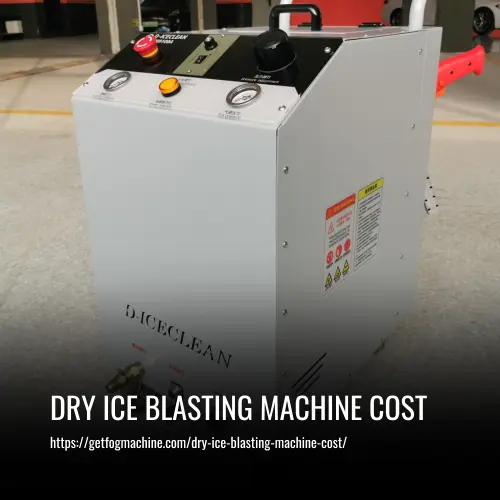
A dry ice blasting machine costs between $1,000 for a basic portable unit and over $200,000 for a top-tier industrial system. The real price is the total cost of ownership: add a $5,000-$10,000 air compressor, $0.30-$3.90 per pound for dry ice pellets, and $200-$1,000+ annually for maintenance.
Most buyers fixate on the machine’s sticker price. They forget the air compressor that powers it, the pallet of dry ice that vanishes in a week, and the nozzle that wears out after sixty hours of grit. That sticker is a down payment.
This guide maps the full financial landscape. We’ll break down machine price tiers, itemize every hidden cost, and show you the math for renting versus buying.
Key Takeaways
- The air compressor often costs more than the blasting machine itself. An undersized unit jams the feed system and wastes dry ice.
- Dry ice pellets are a consumable, not a supply. Budget for 1.5 to 2.5 pounds per minute of runtime, plus 5-10% loss to sublimation in storage.
- Renting makes sense for fewer than ten projects a year. Daily rates run $175 to $1,500, but you avoid the compressor investment.
- Premium brands like Cold Jet cost 30-50% more upfront. Their true value is in parts availability five years later when the budget machine is scrap.
- Operator safety is non-negotiable. The process hits 120+ decibels. Factor $200-$500 for certified hearing protection, goggles, and gloves into your startup budget.
The Real Price Range: From Portable to Industrial
Headline prices are useless without context. A $1,500 “blaster” from an online marketplace is a toy next to a $25,000 workhorse. The difference isn’t just durability.
Dry ice blasting machines are categorized by pellet throughput, air consumption, and duty cycle. Portable units (≤50 lbs/hour pellet capacity) serve automotive and restoration shops. Mid-range models (50-150 lbs/hour) handle light industrial cleaning. Industrial systems (150+ lbs/hour) are for continuous operation in factories or large-scale mold remediation.
Portable units start around $1,000. They feel light, use plastic feed mechanisms, and often lack variable flow controls. For a hobbyist cleaning one engine block a month, it might suffice. For a shop doing two a week, the plastic auger strips its threads by the third month.
Mid-range machines from $3,000 to $25,000 are the sweet spot for serious small businesses. Think brands like Aiolith. They use metal feed systems, offer adjustable pressure, and can run for an hour without overheating. This is where you stop buying a tool and start buying an asset.
Industrial-grade systems begin at $10,000 and climb past $200,000. These are built for 8-hour shifts, have automated recovery systems, and demand three-phase power. You see them in aerospace or food processing plants. The price includes a service contract.
TL;DR: Buy for your busiest week, not your average day. A $8,000 mid-range machine that runs four hours straight pays for itself; a $1,500 portable that jams after thirty minutes is a paperweight.
What Actually Drives the Sticker Price?
Five factors determine whether a machine costs $5,000 or $50,000. Brand reputation is one. The others are less obvious but matter more on Tuesday morning when you have a job to finish.
Build quality and materials decide lifespan. A cast aluminum feed chamber costs three times more than a molded plastic one. It also lasts ten times longer when blasting abrasive carbonized grease. The plastic version cracks under thermal stress from the -109°F dry ice.
Pellet throughput and air consumption are linked. A machine rated for 100 lbs/hour needs an air compressor delivering at least 200 CFM at 100 PSI. Higher throughput means a bigger, more expensive air end and heavier-duty solenoid valves. That’s why capacity scales price exponentially, not linearly.
Control and feedback systems separate professional tools from gadgets. A simple dial vs. a digital touchscreen with programmable presets for different media (grease, paint, mildew) might be a $4,000 difference. The digital system saves 15 minutes per job on guesswork and reduces dry ice waste by 20%.
Ergonomics and duty cycle matter if you’re the one holding the gun. A well-balanced hose assembly and a trigger with progressive pressure reduce operator fatigue. A cheap gun is heavy, stiff, and leads to repetitive strain inside a week. Good ergonomics add $500-$2,000 to the bill.
Warranty and service network is the final, critical factor. A one-year warranty on parts suggests the manufacturer expects failures. A three-year warranty with next-day parts shipping costs more upfront but eliminates $1,500 downtime events. This is where brands like Cold Jet justify their premium.
| Feature | Budget Machine (<$5,000) | Professional Machine ($10,000-$30,000) | Consequence of Choosing Budget |
|---|---|---|---|
| Feed Mechanism | Plastic auger or simple gravity | Stainless steel screw feed with anti-jam | Jam every 2-3 hours; requires full teardown to clear |
| Air Control | Manual regulator, no gauge | Digital PSI/CFM readout with feedback | Inconsistent blast pattern; wastes 30% more dry ice |
| Hose & Gun | Standard rubber hose, basic gun | Anti-static hose, ergonomic gun with quick-change nozzles | Hose stiffens in cold; operator fatigue cuts daily output in half |
| Warranty | 90 days parts, labor not included | 3 years parts & labor, onsite service available | First major repair costs 40% of machine price at 13 months |
The Hidden Costs That Sink Budgets

The machine is the tip of the financial iceberg. The three costs below the waterline—air, ice, and upkeep—determine your actual profit margin.
Before you start: Dry ice blasting generates noise exceeding 120 dB, which can cause permanent hearing damage within minutes. It also projects frozen debris at high velocity. Always wear ANSI-rated safety goggles, a full-face shield, and certified hearing protection (muffs, not plugs). Never operate without cut-resistant gloves.
The Air Compressor is the Real Investment. This is the most common and costly oversight. Your shop’s 20-gallon compressor outputs maybe 5 CFM. A modest dry ice blaster needs 40 CFM at minimum. Industrial units demand 200-450 CFM.
A new compressor that delivers 40-60 CFM at 100+ PSI costs $5,000 to $10,000. A diesel tow-behind unit for big jobs runs $15,000+. If you skimp here, the blaster starves for air. The pellets don’t accelerate, they tumble out and sublime on the surface instead of blasting it. You burn through double the dry ice for half the cleaning.
Dry Ice Pellets: The Vanishing Consumable. You don’t buy dry ice, you rent it. It sublimates (turns directly to gas) at about 5-10% per day, even in a specialized freezer. The cost varies wildly: $0.30 per pound for a full pallet delivered to an industrial park, $3.90 per pound for a 20-pound batch from a local supplier.
Consumption is the real metric. Machines use 1.5 to 2.5 pounds of pellets per minute of trigger time. A one-hour job consumes 90 to 150 pounds. At $1.50 per pound average, that’s $135 to $225 just in ice. And you must schedule delivery for the day of the job.
Maintenance and Parts Reality. This isn’t a lawnmower. Nozzles wear out from abrasion. The feed hose develops micro-cracks. Solenoid valves fail from moisture.
Common mistake: Using the same nozzle for grease and paint overspray — the hardened steel nozzle lasts 50+ hours on grease but erodes in under 10 hours on paint abrasives, causing an uneven fan pattern that leaves streaks.
Annual maintenance runs $200 to $1,000 for a professional machine. A budget machine might need that in parts every three months. A replacement feed motor for a mid-range unit can be $800. If you bought a no-name brand, that part simply doesn’t exist anymore.
Renting vs. Buying: The Break-Even Math

The choice isn’t about convenience. It’s a spreadsheet question of utilization rate. Run the numbers wrong and you either tie up capital or bleed cash on rentals.
Renting is for Specific, Infrequent Projects. Need to clean the molds in your injection molding plant once a year? Rent. Daily rates range from $175 for a small portable unit to $1,500 for an industrial rig with a compressor. Weekly rates offer a discount, typically $1,400 to $5,000.
The renter provides the machine, the compressor, and sometimes the initial dry ice. You pay for the pellets you use. This is perfect for a one-time restoration, a post-fire cleanup, or testing the process before a purchase.
Buying is for Steady, Predictable Work. The rule of thumb from equipment finance: if you’ll use the machine more than ten times a year, buying is cheaper. The math is straightforward. Ten single-day rentals at $500 each is $5,000. That’s the down payment on a $10,000 machine you’ll own for five years.
Financing is common. A $20,000 machine on a 5-year loan might cost $400 per month. If that machine generates $2,000 of billable work per month, the ROI is clear. Ownership also lets you master one tool’s quirks and build speed.
| Scenario | Rent | Buy | Winner |
|---|---|---|---|
| Automotive Shop (2 jobs/month) | ~$1,000/month rental + ice | ~$600/month loan + ice + maintenance | Buy – pays off in <18 months |
| Factory (Annual Mold Clean) | ~$3,000 one week rental | ~$20,000 capital outlay + storage | Rent – utilization too low |
| Disaster Restoration Contractor | Unpredictable, high-cost rentals | Enables fast response, fixed cost | Buy – critical for business model |
| Hobbyist Restorer (1 car/year) | ~$500 annual rental | $8,000 depreciating asset | Rent – no storage, no maintenance |
I financed my first mid-range blaster for my event production company, thinking it would pay for itself in a year on stage cleaning contracts. I was right about the work, but wrong about the compressor. My existing unit couldn’t keep up, causing constant jams. The $8,000 compressor I had to add later turned an 18-month ROI into a 3-year slog. Now I tell everyone to price the air system first.
Hiring a Professional Service: When It Makes Sense

Sometimes, the most cost-effective machine is a phone call. Hiring a dry ice blasting service eliminates every capital and training cost. You pay for a result.
Service rates are typically $395 per hour in major US markets, with minimums of 2-4 hours. For defined projects, they quote flat rates: $1,000 to $3,000 for a full vehicle undercarriage restoration, or $3.50 to $5.00 per square foot for industrial floor cleaning.
This path makes sense when the job is complex, a one-off, or requires certification you don’t have (like food plant cleaning). The service brings the industrial machine, the massive compressor on a truck, the dry ice, and the certified operator. Your cost is known upfront.
The downside is scheduling and lack of control. You’re on their calendar. For ongoing, smaller tasks, the service model gets expensive fast.
How to Avoid Costly Mistakes
New buyers make two expensive errors. One is buying too small. The other is ignoring the support ecosystem.
Mistake 1: Prioritizing Price Over Total Cost of Ownership. A $3,000 machine with a $200 nozzle that lasts 20 hours has a consumable cost of $10 per hour. A $10,000 machine with a $400 nozzle that lasts 100 hours costs $4 per hour. The cheaper machine has a higher operating cost from day one. Add in downtime, and the “bargain” loses money.
Mistake 2: Assuming Your Shop Air is Enough. Go check your compressor’s spec plate. Now compare it to the dry ice blaster’s requirements, which are always for continuous CFM, not peak. The mismatch is almost guaranteed. That’s why dry ice fog machines for special effects have simpler air needs than industrial blasters. Assuming otherwise burns out your compressor in a month.
Mistake 3: Overlooking Dry Ice Logistics. You need a supplier within a one-hour drive. You need a storage freezer that holds at least -85°F. You need to plan jobs to use a delivery within 24 hours. If any link in that chain breaks, you’re paying for a machine that sits idle. This logistical hurdle is a primary reason many opt for a professional fog machine for atmospheric effects instead of diving into dry ice blasting.
Do your homework on local suppliers before signing a purchase order. Their reliability is part of your machine’s functionality.
Frequently Asked Questions
Can I use a dry ice blaster without a specialized air compressor?
No. Standard shop compressors lack the sustained volumetric flow (CFM). An undersized compressor causes pressure drops that lead to feed jams, inconsistent cleaning, and massive dry ice waste. It’s the single most cited reason for project failure.
How much does dry ice cost for a typical job?
For a mid-sized job like cleaning a commercial kitchen hood system (2-3 hours of blasting), you’ll consume 200-400 pounds of pellets. At an average cost of $1.50 per pound, the dry ice alone costs $300 to $600. This is why accurate time estimates are critical for quoting.
Is a used dry ice blasting machine a good deal?
Maybe, but inspect it like a used car. The critical wear items are the feed mechanism, solenoid valves, and the compressor’s air end. If the seller can’t demonstrate it running with pellets, walk away. A used professional brand (Cold Jet, KÄRCHER) at 50% off can be a steal. A used no-name machine at any price is a liability.
What safety gear is absolutely mandatory?
Hearing protection (muffs), full-face safety shield, cut-resistant gloves, and long sleeves. The process is extremely loud and projects frozen contaminants. Unlike using dry ice in a fog machine for effect, blasting involves kinetic energy and debris. Never skip PPE.
How long does a dry ice blasting machine last?
well-maintained professional machine from a major brand lasts 7-10 years in moderate use. The lifespan depends almost entirely on preventing moisture from entering the air system (hence the need for a high-quality dryer) and following the prescribed maintenance schedule for the feed system.
The Bottom Line
The price on a dry ice blasting machine is just an entry fee. The real cost is the capable air compressor behind it, the perpetual resupply of vanishing pellets, and the maintenance to keep it from seizing. For sporadic use, renting or hiring a service is smarter calculus. For steady work, buy a mid-range professional machine with a robust service network—it’s the only path to a positive return. Budget for the whole system, or the system will break your budget.